


Pros and Cons of Cloud
Every technology has tradeoffs, and cloud computing is no different. Understanding the pros and cons of cloud helps organizations make informed decisions and maximize value while minimizing risk.
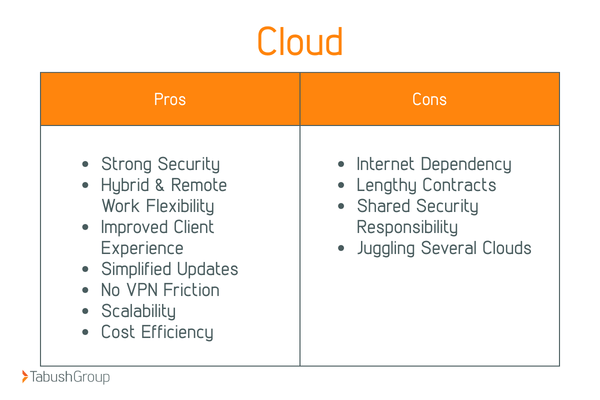
Pros: What Makes Cloud Essential?
Cloud adoption continues to accelerate, and for good reason. Modern cloud platforms deliver flexibility, scalability, and reliability that on-premise systems often cannot match.
There are several benefits to using cloud over on-premise technology.
1. Strong Security
Modern cloud providers invest heavily in security infrastructure, including encryption, access controls, identity management, and continuous monitoring.
Security becomes systematic, protecting data across multiple environments and reducing the risk of breaches. Organizations gain a stronger compliance posture without building all security internally.
In our 2025 Law Firm survey, 44% or respondents believed that the cloud's greatest benefit is that it enhances security.
2. Flexibility for Hybrid and Remote Work
Work happens everywhere now. Cloud allows teams to access data and applications from any location or device, supporting hybrid and remote work seamlessly.
In our survey, 66% of firm leadership said the most significant benefit of cloud technology is the ability to work from anywhere.
Additionally, resources can scale up or down depending on demand, giving businesses the flexibility to adapt without major infrastructure investments.
3. Better Client Experience
Cloud systems provide high availability and reliable performance, ensuring users and clients can access services without interruption. Downtime is minimized, response times improve, and organizations can deliver a smoother, more consistent client experience.
This consistency builds trust, and trust drives retention.
4. Simplified Updates
Updates and patches are handled by the cloud provider. Systems remain current and secure without the need for your intervention.
This reduces operational disruption and ensures applications and security measures are always up to date. 48% of firm leaders surveyed in our 2025 Law Firm survey site reported that one of the greatest benefits of cloud is that it makes software updates easier.
5. No VPN Struggles
Traditional VPNs can create friction and slow performance. Cloud-hosted applications provide secure access without relying on complex VPN setups.
Employees can connect faster, access resources more easily, and maintain productivity from anywhere.
6. Better Support
Most cloud platforms provide 24/7 support, monitoring, and incident response. Issues are detected early, and support teams can troubleshoot faster than with on-premise infrastructure.
This ensures operational continuity and greater confidence in IT systems.
7. Scalability
Growth shouldn’t break your infrastructure. Cloud platforms allow organizations to scale resources dynamically based on demand. Whether adding users, deploying new services, or handling traffic spikes, with cloud, resources expand seamlessly while performance remains stable.
Plus, cloud management simplifies infrastructure while reducing operational overhead. You get a smaller IT footprint with greater control.
In our survey, 53% of leaders see the cloud's ability to easily scale IT resources as the most important.
8. Cost Savings
Cloud adoption reduces costs by eliminating the need to purchase, host, and maintain on-premise servers and supporting infrastructure. Instead of investing in expensive hardware, upgrades, and ongoing maintenance, organizations rely on cloud providers to manage the underlying systems.
45% of respondents from our 2025 Law Firm Survey highlight cost savings on hardware as the greatest benefit of cloud.

Cons of Cloud
While cloud offers clear advantages, it comes with challenges that organizations should consider before adoption.
1. Internet Connectivity
Cloud systems rely entirely on a stable and reliable internet connection. Any downtime, latency, or slow network performance can disrupt operations, prevent employees from accessing critical applications, and delay service delivery to clients.
Organizations must invest in redundant internet connections and performance monitoring tools to ensure uninterrupted access. Even with these measures, connectivity issues, such as local outages or bandwidth limitations, can affect productivity, making internet dependency a critical factor in cloud adoption.
2. Security Concerns
While cloud providers invest heavily in security infrastructure, including encryption, monitoring, and access controls, human error and misconfiguration remain significant vulnerabilities.
Improperly set permissions, unpatched applications, or unsecured endpoints can expose sensitive data to breaches.
Organizations must implement strong internal security policies, continuous monitoring, and regular audits to complement provider protections. Security is a shared responsibility, and failure to properly manage cloud configurations can undermine even the most robust cloud platform.
3. Juggling Several Cloud Solutions
Organizations often adopt multiple cloud services to meet different business needs: SaaS for productivity, IaaS for infrastructure, and specialized platforms for CRM, analytics, or project management.
While each tool solves a specific problem, managing several solutions simultaneously can quickly become overwhelming.
Without a clear strategy, a multi-cloud environment can create several challenges.
Cloud Sprawl
Cloud sprawl occurs when redundant, underutilized, or abandoned resources accumulate across multiple platforms. These idle resources not only increase costs but also create operational inefficiencies.
Over time, sprawl can make it difficult to track workloads, manage capacity, and maintain control over the environment.
Low Visibility
Managing multiple cloud solutions often reduces overall visibility into usage, performance, and system health. IT teams may struggle to monitor activity across platforms, making it harder to detect issues, enforce policies, or plan capacity effectively.
Limited visibility also slows down troubleshooting and decision-making, leaving gaps in operational oversight.
Lack of Security and Access Control
When several cloud platforms are in use, policies and permissions can become inconsistent. This increases the risk of misconfigurations, unauthorized access, and potential security breaches.
Without centralized oversight, maintaining compliance, enforcing security protocols, and tracking user activity becomes far more complex.
Managing multiple cloud solutions requires a structured strategy, centralized governance, and integrated monitoring tools. But with cloud management solutions, organizations can turn a complex multi-cloud environment into a manageable and efficient ecosystem.
Why Cloud Management Is Important
In our survey, 39% of firms said they planned to increase their cloud investments in 2025. But while cloud adoption moved fast, cloud management often didn’t.
Businesses rush into cloud platforms to gain speed and flexibility. Without a defined cloud management strategy, those same environments quickly become fragmented, insecure, and expensive.
Here’s the problem: multiple clouds, with multiple vendors, and zero visibility. That’s where cloud management comes in. It brings structure to complexity.
It ensures performance stays consistent, security stays enforced, and costs stay under control. And yes, this matters at every stage of growth.
What Is Cloud Management?
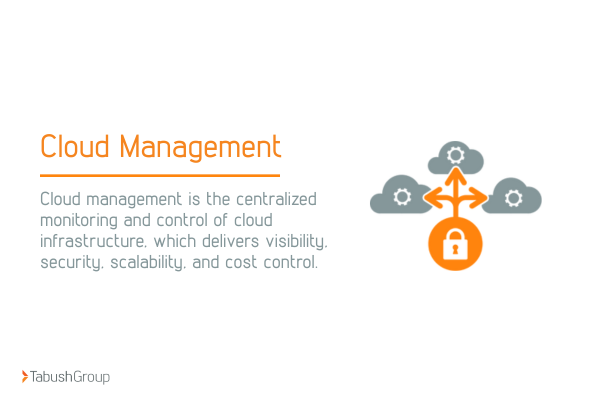
Cloud management refers to the tools, processes, and policies used to monitor, control, secure, and optimize cloud-based infrastructure and services. That includes public cloud environments, private clouds, as well as hybrid and multi-cloud deployments
In simple terms, cloud management ensures your cloud works for your business, not against it.
Cloud management operates through centralized platforms and policies that govern how cloud resources are deployed, monitored, and secured.
This enables:
-
Real-time visibility into cloud usage
-
Automated provisioning and scaling
-
Consistent security enforcement
-
Predictable cost management
And that’s just the beginning.
Benefits of Cloud Management
When cloud environments grow without structure, risk and inefficiency follow. Cloud management brings discipline, visibility, and control, turning cloud investments into measurable business outcomes.
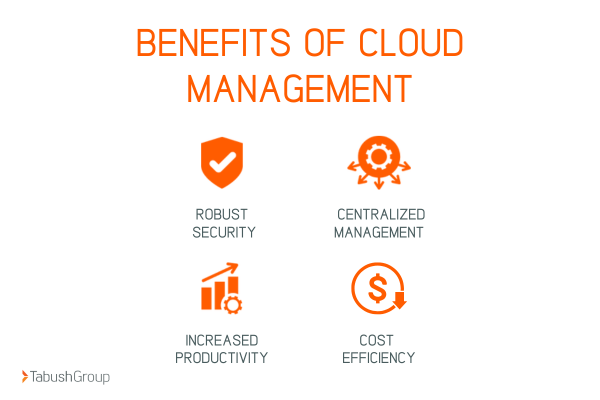
1. Robust Security
Security is the top concern in cloud environments, and for good reason. About 71% of businesses have experienced at least one cloud-related security incident in the last 18 months.
Cloud management enforces consistent security policies across users, devices, applications, and workloads. That consistency eliminates blind spots that attackers exploit.
This includes:
-
Identity and access controls
-
Encryption standards
-
Continuous access monitoring
-
Real-time threat detection
Security policies are applied universally, regardless of where users work or what device they use. This results in reduced attack surfaces, faster incident response, and a stronger compliance posture that scales with your business.
2. Ease of Use
Cloud environments should simplify work, not complicate it. Cloud management platforms streamline daily operations through centralized dashboards, automated workflows, and standardized configurations.
Instead of juggling multiple tools, teams operate from a single interface. Admins gain clarity while users gain consistency.
Provisioning, updates, and access requests happen faster with fewer errors. Manual fixes disappear, and IT teams stop firefighting routine issues. Efficiency becomes the default.
3. Centralized Management
Here’s where cloud management delivers real power. All cloud operations funnel into one unified management layer, creating visibility and control across your entire environment.
That includes infrastructure, applications, security policies, and vendors.
Management comes in several forms:
-
Operational management for uptime and performance
-
Vendor management for contracts and service accountability
-
Performance management for workloads and applications
-
Security management for access and compliance
Everything aligns so nothing slips through the cracks.
4. Increased Productivity
Less friction equals more output. Cloud management removes productivity roadblocks caused by misconfigured resources, delayed access, and system downtime.
Automated provisioning and policy enforcement ensure employees have what they need, when they need it. Teams spend less time troubleshooting and more time delivering value.
An increase in productivity isn’t accidental; it’s engineered through smarter cloud operations.
5. Cost Control
Cloud costs spiral fast without oversight. Nearly 48% of organizations identify rising cloud costs as a top cloud management challenge. Cloud management introduces budgeting, forecasting, and cost allocation controls that prevent overspending before it happens.
Usage is tracked in real time, and resources are rightsized automatically. You see exactly where money goes, so you can stop paying for what you don’t use.
Over time, cloud spending becomes predictable, optimized, and aligned with business goals, rather than a recurring surprise.
How Cloud Management Works
Cloud management isn’t just a buzzword; it’s the backbone of an efficiently run cloud environment. It ensures that resources are optimized, secure, and aligned with business goals.
Here’s how it works day-to-day.
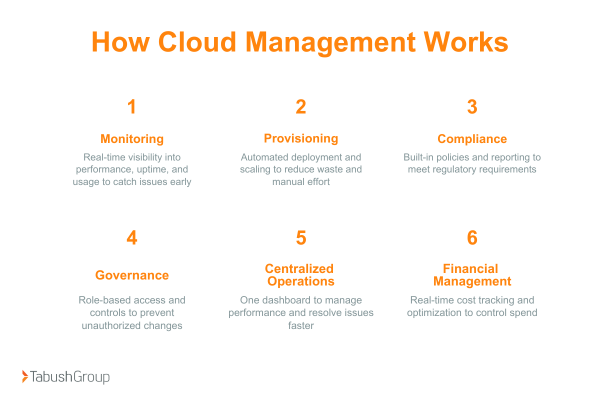
1. Monitoring
Monitoring acts as the eyes and ears of your cloud environment, providing real-time insight into performance, uptime, and resource usage. Every server, application, and workload is continuously tracked, allowing IT teams to detect problems before users experience them.
This proactive approach helps identify inefficiencies before they become costly, while advanced monitoring tools can flag anomalies or unusual behavior, enabling teams to respond immediately to potential performance issues or security threats.
2. Provisioning
Provisioning automates the deployment, scaling, and decommissioning of cloud resources. Instead of relying on manual setup, resources are allocated when needed and removed when no longer required, ensuring optimal capacity and cost efficiency.
Automation reduces human error and frees IT staff to focus on strategic initiatives rather than routine configurations, while also supporting dynamic workloads, seasonal spikes, and project-based teams seamlessly.
3. Compliance
Compliance is a critical requirement, especially in regulated industries such as finance, healthcare, and legal services. Cloud management enforces regulatory requirements through standardized policies, automated controls, and audit-ready reporting.
This approach ensures that rules are consistently applied, risks remain contained, and compliance reports can be generated quickly, reducing both human error and administrative burden on internal teams.
4. Enterprise Governance and Control
Enterprise governance defines who can access what and under which circumstances. Cloud management applies role-based access, approval workflows, and usage policies across the organization, eliminating unauthorized changes and preventing shadow IT.
By maintaining clear accountability, governance helps protect sensitive data and ensures that all cloud activity aligns with business objectives.
5. Centralized Operations Management
Operations teams need clear visibility across multiple cloud environments, and centralized management provides just that. By consolidating operations into a single control plane, IT staff can monitor system health, track performance metrics, and resolve issues more quickly.
Centralized operations also make it easier to optimize workloads, reduce underutilized resources, and streamline collaboration between teams, turning operational efficiency into a consistent standard.
6. Financial Management
Financial management transforms the cloud from a simple cost center into a strategic investment. Cloud management tools track spending in real time, forecast future costs, and highlight areas for optimization.
This visibility allows organizations to enforce budgets, monitor usage trends, and implement cost-saving measures effectively, ensuring that cloud spending is predictable, optimized, and aligned with business priorities.
Cloud Management Strategies
Strategy separates success from struggle. Without one, cloud environments drift into chaos.
The most effective cloud management strategies focus on visibility, control, and scalability, without slowing teams down.
Here’s how to get it right.
1. Cloud Visibility
You can’t manage what you can’t see. Cloud management provides real-time visibility into resources, usage patterns, performance metrics, and security posture across every cloud environment.
No blind spots and no assumptions. With complete visibility, IT teams can identify inefficiencies, detect anomalies early, and make data-driven decisions instead of reactive fixes.
2. Simplify Migration
Migration should be structured, not rushed. Cloud management solutions support phased migrations that reduce operational disruption and minimize risk.
Workloads move in controlled and well-planned stages, ensuring systems remain stable and users stay productive.
Dependencies are mapped, and risks are flagged, so downtime stays minimal. Smooth migrations build momentum and set the foundation for long-term cloud success.
3. Enable Integration
Disconnected systems slow teams down. Cloud management enables seamless integration across applications, platforms, and workflows, creating a unified cloud ecosystem.
Data flows freely between tools instead of living in silos.
-
Processes align
-
Automation improves
-
Manual work disappears
Efficiency compounds when systems work together instead of against each other.
4. Optimize Resource Usage
Overprovisioning wastes money, but underprovisioning hurts performance. Underutilized resources account for an estimated 28–35% of total cloud waste, showing why effective monitoring is critical.
Cloud management continuously analyzes usage trends and automatically rightsizes resources to match demand.
This ensures workloads perform optimally without unnecessary spend. This means:
-
Scaling becomes dynamic
-
Costs stay controlled
-
Performance remains consistent
Your optimization should be ongoing, not reactive.
5. Create Governance
Governance keeps cloud environments aligned with business goals. Cloud management enforces policies around security, access, compliance, and usage across all cloud resources.
Role-based access controls and automated compliance checks reduce risk without adding friction.
-
Rules stay consistent
-
Teams stay productive
-
Audits become easier
This is control without complexity, and security without slowdowns.
How to Choose the Right Cloud Management Solution
Choosing the right cloud management solution is critical to maximizing performance, security, and efficiency in your cloud environment.
The right solution doesn’t just manage technology; it aligns with your business needs, protects your data, and empowers your team. Here’s what to consider.
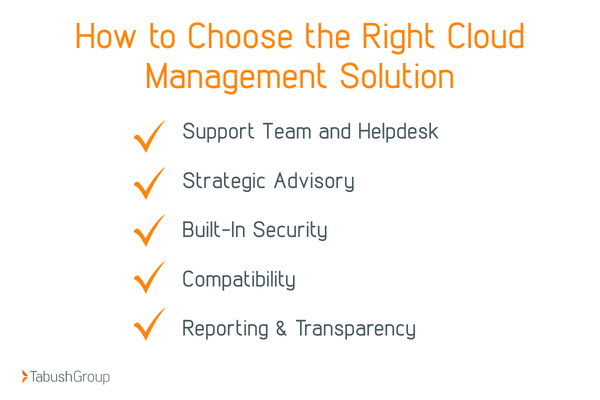
Support Team and Helpdesk
Downtime and disruptions can be devastating to your business. A strong cloud management solution should include a responsive support team that’s available when you need them.
Look for platforms that provide support via multiple channels, such as client portals, email, and phone, and respond quickly to resolve issues. Fast, reliable support ensures that your operations continue smoothly, minimizing disruptions and lost productivity.
Strategic Advisory
Cloud management isn’t just about technology; it’s about strategy. The best solutions offer proactive guidance, such as assigning a dedicated virtual CTO or advisor who understands your business.
This expert provides recurring consultations to ensure your IT investment aligns with business goals. With strategic advisory, your cloud management solution becomes a partner in growth, helping you make informed decisions, optimize resources, and anticipate future needs.
Built-In Security
Security and compliance should be embedded, not bolted on. Look for solutions that enforce consistent security policies, role-based access controls, 24/7/365 monitoring, and detection
SOCaaS and automated compliance checks across all cloud environments.
This ensures sensitive data is protected, regulatory requirements are met, and governance is maintained without slowing down teams.
Compatiability
Compatibility is critical. Your cloud management solution should support the applications and systems you already use, including legacy software, industry-specific tools, and modern SaaS platforms.
Seamless integration prevents workflow disruptions, reduces migration risk, and ensures teams can continue working without reconfiguring or replacing essential applications.
Reporting and Transparency
Visibility into your cloud environment is essential. A high-quality cloud management solution provides comprehensive reporting and full transparency into performance, security, and support activities.
You should be able to track uptime, monitor security measures, review maintenance tasks, and assess how IT investments impact productivity. Clear, detailed reports allow decision-makers to verify that cloud systems are meeting business objectives and mitigating risks effectively.
By prioritizing support, strategic guidance, and transparent reporting, organizations can choose a cloud management solution that not only maintains systems but also drives efficiency, safeguards data, and aligns IT with business strategy.
Get Secure Cloud Management Solutions
Cloud success doesn’t come from technology alone. It comes from expert management.
Cloud environments grow fast, and without cloud management, they grow dangerous. Now it’s time to transition from reactive cloud usage to an intentional cloud strategy.
If your organization is ready to simplify operations, strengthen security, and scale without friction, ask yourself this: Who’s managing your cloud today?
Partner with Tabush Group, which understands performance, security, and scalability, because your cloud should accelerate your business, not slow it down.
Overture, our cloud management solution, is designed to eliminate complexity, strengthen security, and scale with your business. We help organizations regain visibility, control costs, and operate with confidence, no matter how complex their cloud environment becomes.
Start managing your cloud the right way.