What is DaaS? Desktop as a Service (DaaS) is a cloud computing model that delivers a complete Windows desktop — your applications, files, and settings — from a secure data center to any device over the internet. Because the desktop is streamed rather than run on the local machine, people work the same way whether they are in the office, at home, or on the go, and company data remains securely in the data center instead of on the device.
Key takeaways
-
DaaS streams a managed Windows desktop from the cloud, so applications and data live in the data center, not on the end-user device.
-
The main benefits are a familiar desktop experience, security that follows the user, simpler IT, predictable per-user pricing, and built-in backup and business continuity.
-
DaaS shifts IT spending from capital expense (CapEx) to operating expense (OpEx), which usually lowers long-term cost.
-
Demand is growing quickly: the desktop virtualization market is projected to grow from about $41.9 billion in 2026 to $174.3 billion by 2034, a 19.5% CAGR (Fortune Business Insights), driven largely by hybrid work and BYOD.
-
Boxtop is Tabush Group's DaaS solution: a fully cloud-based Windows desktop monitored 24x7x365.
By now, you are likely familiar with the term cloud for your business – when servers reside in data centers and are accessed over the internet, rather than physically sitting in a room at your office.
You likely are also aware there are benefits of cloud, such as being more secure and accessible from anywhere.
But did you know that cloud can be leveraged by your firm in a few ways? Do you know which is best for your firm?
While there are a few options available, DaaS is rising in popularity.
So what Is DaaS and why should businesses implement it?
What is DaaS?
Desktop as a Service (DaaS) is a cloud computing solution that allows users to access their desktop environment.
This enables your team to access everything, including your applications and files. Because these virtual desktops are streamed from the cloud, they are accessible securely and seamlessly from any device and any location.
Demand for cloud desktops keeps climbing. The desktop virtualization market is projected to grow from about $41.9 billion in 2026 to $174.3 billion by 2034, a 19.5% CAGR (Fortune Business Insights), and the shift to hybrid and remote work is one of the biggest reasons why. For many firms, the question is no longer whether to move to the cloud, but which model to use.
Top 8 Benefits of DaaS
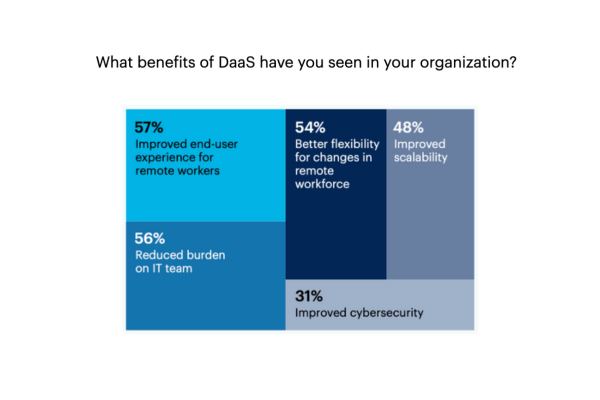
Desktop as a Service (DaaS) is revolutionizing the way businesses manage their IT infrastructure. By delivering applications and desktops from the cloud, DaaS offers unparalleled flexibility, security, and efficiency.
Here are the top eight benefits of adopting DaaS for your business.
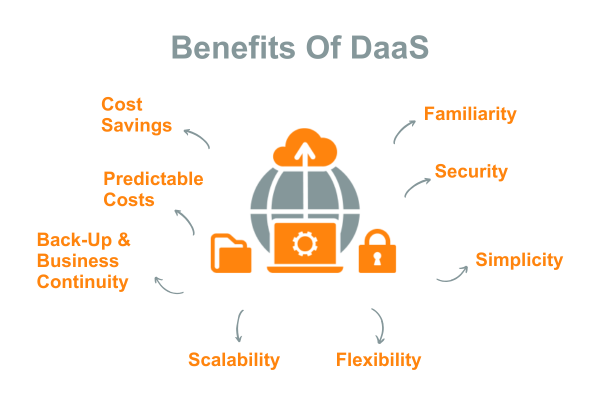
1. Familiarity
One of the major advantages of DaaS is that users can work on a familiar desktop such as Windows 11, using the same applications and network share drives they are accustomed to.
This means there is nothing new to learn, which eliminates the learning curve and ensures a smooth transition. Employees can continue to work efficiently without having to adapt to new systems or software interfaces.
2. Security
Regardless of where you are working or what device you are using, you are always securely accessing your data and applications when utilizing a DaaS cloud solution. Your security is truly elastic.
In other words, it stretches beyond your office walls to ensure all users are always working in a secure manner.
3. Simplicity
Cloud simplifies a firm’s IT from both technical and business standpoints. With DaaS, all applications and data are accessible from a single cloud desktop.
All systems run within a single security framework, and everything is fully backed up and replicated by a single backup and business continuity system.
4. Flexibility
Employees can access programs, desktops, and data from anywhere, at any time. This means businesses can support remote work seamlessly. For a closer look at what makes remote work reliable and secure, see our guide to the top remote access challenges and how to solve them.
Additionally, resources can be adjusted based on needs, allowing for greater adaptability in dynamic business environments.
5. Scalability
DaaS allows businesses to scale their IT infrastructure effortlessly. You can seamlessly add or remove users as needed, ensuring that your IT resources match your current business requirements.
This scalability is particularly beneficial for growing businesses or those with fluctuating workloads. With DaaS’s quick setup, businesses can onboard new employees or implement new systems without lengthy delays.
6. Back-Up & Business Continuity
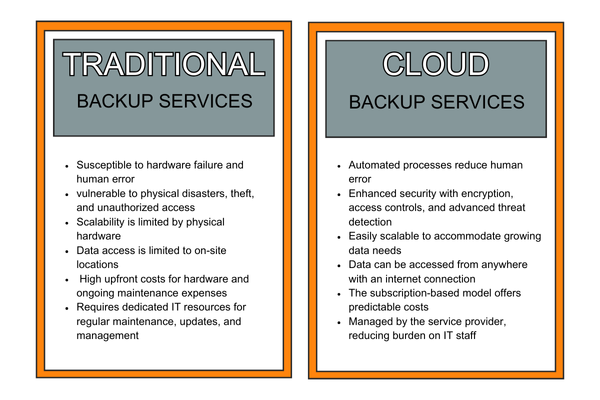
Backup and business continuity are inherent parts of a DaaS cloud solution. Everything is regularly backed up to the private cloud, ensuring that data is always protected and recoverable.
There is no need to purchase and maintain separate backup systems, as DaaS providers handle all aspects of data protection and recovery.
7. Predictable Costs
DaaS typically involves a monthly per-user fee to the provider, which makes IT costs predictable and manageable.
There are also no hidden extra equipment or service costs, as the infrastructure is hosted in the cloud.
8. Cost savings
DaaS moves IT infrastructure to the cloud, which means that firms no longer have to buy laptops and internal servers.
Expenses transition from capital expenditures (CapEx) to operational expenditures (OpEx), which generally shows long-term savings.
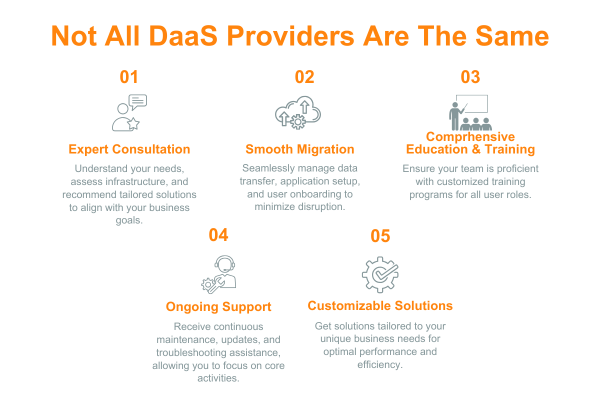
How the Right DaaS Provider Can Make Implementation Easy
Implementing Desktop as a Service (DaaS) can transform your business. However, the success of DaaS largely depends on choosing the right provider.
Here are the key ways the right DaaS provider can make implementation stress-free.
Expert Consultation
The first step in implementing DaaS is understanding your business needs and goals.
A reputable DaaS provider will offer expert consultation to:
- Assess your current IT infrastructure
- Identify your requirements
- Recommend the best solutions
This personalized approach ensures that the DaaS solution aligns with your business objectives, enhances efficiency, and provides a solid foundation for future growth.
Smooth Migration
Transitioning from traditional IT infrastructure to DaaS can be complex, but a skilled DaaS provider will manage the migration process seamlessly.
To ensure minimal disruption to your business operations they use their experience to handle:
- Data transfer
- Application setup
- User onboarding
The provider will also ensure that all your data is securely migrated and that there is no loss of information during the transition.
Comprehensive Education & Training
A successful DaaS implementation requires that your team is comfortable and proficient with the new system.
A reliable DaaS provider will offer comprehensive education and training programs to ensure your employees understand how to use everything effectively.
Training sessions can be customized to suit different user roles, ensuring everyone from IT staff to end-users is well-prepared.
Ongoing Support
The right DaaS provider doesn’t just disappear after the initial setup. They offer ongoing support to address any issues that may arise and to ensure your system is always running smoothly.
This includes regular
- Maintenance
- Updates
- Troubleshooting assistance
Having a dependable support team means you can focus on your core business activities without worrying about IT problems.
Customizable Solutions
Every business is unique and a one-size-fits-all approach rarely works. A competent DaaS provider will offer customizable solutions that can be tailored to fit your specific needs.
A good provider will work with you to create a DaaS solution that perfectly matches your business demands.
Implement DaaS to Leverage Cloud Seamlessly
Boxtop is our fully cloud-based Windows desktop. All of your applications and data live in the same cloud, making them seamlessly accessible from any device, at any time.
With fully redundant systems that are monitored 24x7x365, you can always trust your data is safe with Boxtop.
For more information on our DaaS solution, check out our short demo video and request your free trial.
Weighing DaaS against your current setup? It also simplifies thornier IT problems like managing personal devices under a BYOD policy. And if you want an objective read on where your IT stands before making any change, a 360 IT Assessment reviews your current environment and points to areas to improve efficiency and security.
Frequently Asked Questions
What is Desktop as a Service (DaaS)?
Desktop as a Service (DaaS) is a cloud model in which a provider hosts and delivers a full Windows desktop — applications, files, and settings — from a data center to any device over the internet. The desktop is streamed to the user, so the work environment and company data stay in the cloud rather than on the local machine.
What is the difference between DaaS and VDI?
Both deliver virtual desktops, but the difference is who runs the infrastructure. With Virtual Desktop Infrastructure (VDI), your organization builds and maintains the servers, storage, and virtualization software in-house. With DaaS, a provider owns and manages that infrastructure and delivers the desktops as a subscription, so there is no hardware to buy or maintain, and costs are predictable per user.
Is DaaS more secure than a VPN?
For most firms, yes. A VPN only secures the connection between a device and the network; if that device is unmanaged or already compromised, the VPN can carry the problem straight into your systems. With DaaS, the work happens on a managed cloud desktop behind the provider's firewalls and encryption, and the local device only displays it — which keeps company data off personal machines and reduces the public Wi-Fi attack surface.
How much does DaaS cost?
DaaS is typically billed as a flat monthly fee per user, which covers the hosted desktop, storage, backup, and maintenance. Because there are no servers or end-user machines to buy and refresh, spending moves from large periodic capital costs to a steady operating expense that scales up or down as your headcount changes.
Is DaaS a good fit for small and mid-sized firms?
It often is. Professional service firms with roughly 20 to 150 staff tend to benefit most, because DaaS gives every user a secure, consistent desktop without the burden of running their own data center. It also simplifies onboarding, offboarding, and supporting remote and hybrid staff. Boxtop is Tabush Group's DaaS solution built for exactly this kind of firm.