


What Are Managed IT Services?
Managed IT services are the ongoing technology tasks, support needs, and security responsibilities that businesses outsource to a third-party expert.
These services may include:
- Network Monitoring: Continuous oversight to prevent downtime and detect issues early.
- Cybersecurity Protection: Advanced threat detection, firewalls, antivirus, and compliance support.
- Cloud Management: Secure setup, monitoring, and optimization of cloud environments.
- Help Desk Support: Quick resolution for employee IT issues and end-user support.
- On-Site Technical Support: Physical presence, when required, for complex problems.
- Data Backups and Disaster Recovery: Automated backups and recovery plans to minimize business interruption.
- Software Patches and Updates: Ensuring systems and applications remain secure and current.
- System Maintenance: Proactive upkeep to prevent downtime and improve performance.
Think of managed IT services as having a fully staffed IT department, albeit external, yet more affordable and with a high level of expertise.
Why Are Businesses Embracing Managed Service Providers?
Businesses today face complex, constantly evolving IT challenges that are difficult to manage with an in-house team alone. Managed Service Providers have become essential partners for small and midsize professional services firms to handle these complex issues.
Many firms lack the expertise or resources to handle specialized areas such as advanced cybersecurity, cloud infrastructure, compliance, and disaster recovery. MSPs bring expert knowledge that small internal teams often can’t provide, ensuring systems are secure, efficient, always-on, and aligned with business goals.
Plus, with technology and cyber threats constantly evolving, MSPs provide proactive monitoring, maintenance, and strategic guidance, allowing firms to focus on clients rather than IT problems.
How Industries Are Embracing MSP Support
Here are a few key industries that are partnering with MSPs for enterprise-level IT capabilities and scalable growth without the cost of a full internal team.
1. Law Firms
Cyberthreats are evolving at lightning speed, and law firms are top targets. Why? Because your data is priceless, including client records, case files, financial information, and confidential communications.
According to our 2025 Law Firm Survey, 80% of law firms surveyed now outsource some or all of their IT to an MSP.
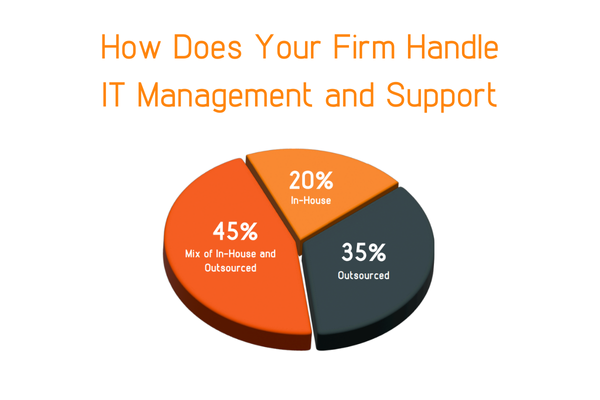
That’s not a trend, it’s a wake-up call. Firms are realizing they cannot afford the risk, downtime, or exposure that comes with outdated or under-resourced IT environments.
2. Accounting Firms
Accounting firms handle sensitive financial data year-round, not just during tax season. MSPs provide them:
- Stronger cybersecurity to protect client financials
- Reliable systems during peak workloads
- Automated backups and compliance support
- Help desk coverage when staff and clients need fast answers
With regulatory pressures increasing, many accounting firms are turning to MSPs to reduce liability and prevent data breaches that could destroy client trust.
3. Financial Services
Banks, investment firms, wealth managers, and lending institutions face some of the strictest compliance requirements in business. Working with an MSP helps them:
- Maintain secure, compliant networks
- Monitor for threats 24/7
- Protect client assets and financial records
- Support secure remote work for advisors
- Reduce downtime that could disrupt client transactions
In a high-risk, high-regulation industry, MSPs provide the stability and oversight that financial firms depend on.
4. Real Estate Companies
From multi-office brokerages to property management teams, real estate companies rely heavily on cloud tools, mobile devices, and constant communication. MSPs support them by:
- Securing client data and transaction files
- Keeping CRM and listing platforms running smoothly
- Supporting agents who work remotely or on the go
- Managing hardware and software across multiple locations
For firms that need flexibility and uptime, MSPs provide the tech backbone that keeps deals moving.
5. Construction Firms
Construction firms are adopting more digital tools than ever, including project management platforms, field apps, GPS systems, and connected equipment. MSPs help by:
- Supporting mobile and on-site teams
- Securing drawings, plans, and contracts
- Managing rugged devices and tablets
- Ensuring cloud-based project tools don’t go down
- Protecting networks from increasingly common ransomware attacks
As construction becomes more tech-driven, MSPs ensure teams stay connected and projects stay on track.
Ways Managed IT Services Can Benefit Your Business
Professional services firms depend on reliable, secure technology to operate efficiently.
But as cyberthreats grow and systems become more complex, many firms find themselves stretched thin. That’s where managed IT services deliver powerful, immediate value.
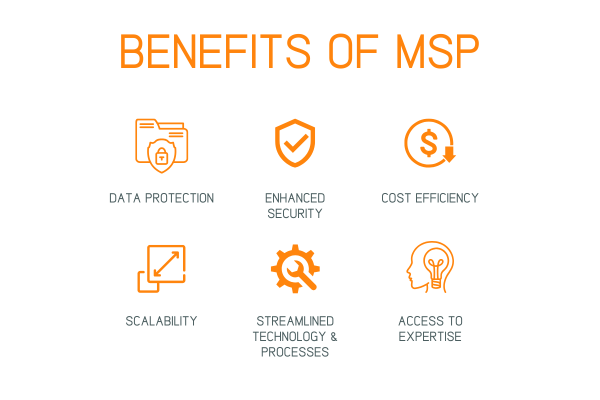
Here’s how an MSP can elevate your performance, protect your data, and keep your business running smoothly.
1. Access to Expertise
Hiring a full internal IT team with specialists in cybersecurity, networking, cloud, compliance, and automation is costly and often unrealistic for small to midsize firms.
An MSP gives you access to a full bench of certified experts, without the recruiting, training, and salary overhead. You get the skills and strategic guidance of an enterprise-level IT department at a predictable monthly cost.
2. Enhance Cybersecurity
Cyberattacks are on the rise, and professional services firms are prime targets. According to our 2025 Law Firm Survey Report, many firms experienced at least one type of cyberbreach.
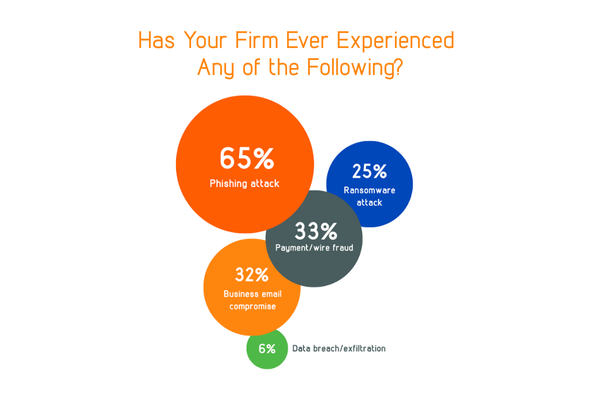
From client records in law and accounting firms to financial data and property documents, a single breach can halt operations and damage your reputation.
According to the IBM Newsroom, the global average cost of a data breach in 2025 was $4.4 million.
Managed IT services provide advanced threat monitoring, data encryption, and rapid response to prevent catastrophic breaches. An MSP helps detect threats early and respond immediately, keeping sensitive information secure and downtime minimal.
3. Multi-Layered Defenses
A strong MSP deploys multi-layered defenses tailored to your industry:
- Firewalls to block unauthorized access
- SOC monitoring for real-time threat detection
- Multi-factor authentication (MFA) to secure logins
- Endpoint protection for all devices
This comprehensive approach reduces risk, ensures compliance, and protects your clients’ trust. You can focus on your core business, while the MSP keeps cyber threats at bay.
4. Cost-Effectiveness
Building an internal IT team with specialists in cybersecurity, networking, cloud, and compliance is expensive. You need to account for:
- Salaries
- Benefits
- Ongoing training
Managed IT services give you enterprise-level expertise at a predictable monthly cost. Small and midsize professional services firms get the same high-level support as large enterprises, without the overhead.
5. Scalable Solutions
Whether your business is expanding, taking on new clients, or adding locations, your technology needs grow too. A managed IT service provider scales resources up or down to match your workload.
But with an MSP, there are no delays, no hiring headaches, no wasted resources.
6. Streamlined Technology and Processes
MSPs modernize workflows, reduce bottlenecks, and eliminate downtime. From accounting software to case management tools to construction project platforms, they help you leverage tools so operations run smoothly.
Your team stays productive, focused, and supported, while your IT runs seamlessly in the background.
Plus, with technology always evolving, your MSP can keep you informed on what’s happening with the latest tools, including AI.
Benefits of Managed Services for Small to Midsize Businesses
Smaller firms often think they’re “not big enough” to need managed IT services, but that’s exactly why an MSP becomes a game changer. Small to midsize businesses typically lack the resources of larger enterprises, but still have enterprise-size IT needs and security requirements.
Even smaller businesses can gain big advantages from an MSP:
- Access to Expertise: Get cybersecurity, cloud, and IT specialists without hiring full-time staff.
- Cost-Effective & Scalable: Pay for only what you need; easily scale as your firm grows.
- Stronger Security: Stay protected with regular updates, patches, and proactive monitoring.
- Proactive Support: Prevent issues before they disrupt your workflow.
- Focus on Clients: Free your team from tech headaches to concentrate on growth and service.
Managed vs. Co-Managed IT Services: Which is Right for You?
You may have heard of the term co-managed IT services, but what makes it different, and when should you do it?
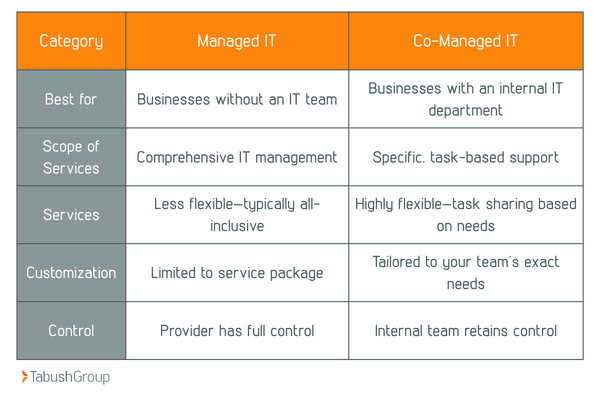
Choosing the right IT approach depends on your firm’s size, resources, and goals.
Fully Managed IT Services
With fully managed IT, the MSP takes complete ownership of your technology operations. This includes everything from network monitoring and cybersecurity to help desk support, cloud management, and backups.
This approach is ideal for businesses without an internal IT team or those with limited resources. You get end-to-end management, proactive monitoring, and 24/7 support, essentially, enterprise-level IT without the overhead of hiring staff.
Smaller firms, particularly those with 1–25 employees, often opt for this model. According to our 2025 Law Firm Survey, 63% of these firms fully outsource their IT to gain access to expertise and free up internal resources.
Co-Managed IT Services
Co-managed IT takes a hybrid approach. Your internal IT team remains in control of core operations, while the MSP provides specialized support, handles heavy workloads, and fills skill gaps.
This model works well for firms with some internal IT capacity but limited bandwidth or expertise in areas like cybersecurity, cloud deployment, or compliance. It allows you to maintain oversight and control while still benefiting from the advanced capabilities and scalable resources of a managed IT service provider.
Firms with 26–50 employees often prefer this hybrid solution, with 53% reporting they leverage co-managed IT to reduce stress on their staff without losing operational control.
How to Choose Between Managed IT Services and Co-Managed IT Services
Ask yourself:
- Do we have an internal team capable of handling most IT tasks?
- Are there specific skill gaps or workloads that overwhelm our IT team?
- How critical is 24/7 monitoring, proactive maintenance, and rapid response for our operations?
If your team is small or overwhelmed, fully managed IT may be the most efficient route. If you already have IT staff but need enhanced expertise or support, co-managed IT can provide the flexibility and balance your business needs.
Misconceptions About IT Services
Even experienced businesses sometimes misunderstand what IT services really involve. Let’s debunk some of the most common myths.
1. Information Technology Is All About the Computers
Many assume IT is just about managing desktops, laptops, and servers.
The truth? IT encompasses far more: security, budgeting, strategic planning, risk management, and aligning technology with your business goals.
A good MSP looks at the bigger picture, ensuring your IT strategy supports growth, compliance, and operational efficiency, not just keeping computers running.
2. “We Are Proactive, You Won’t Have Any Problems.”
No one can promise zero IT issues. Systems fail, networks go down, and cyber threats evolve constantly.
The real value of managed IT services lies in tested backups, continuous monitoring, and reliable ongoing support. Focus on preparedness and responsiveness, not empty guarantees of perfection.
3. New Hardware and Software Will Solve Your Problems
Upgrading technology can help, but it’s rarely a cure-all. IT issues usually have multiple causes, from network configuration to software conflicts and security gaps.
A comprehensive, thoughtful, and experienced approach to troubleshooting is far more effective than simply buying new equipment.
4. Outsourcing to One Company Is the Most Efficient Way to Go
It might seem simpler to rely on a single provider for everything, but that’s not always the most strategic approach.
Specialized vendors can often deliver better results when responsibilities are clearly defined and collaboration is strong.
Efficiency comes from planning, coordination, and choosing the right partners, not from consolidation alone.
What Is A Managed IT Service Provider?
A managed IT service provider (MSP) is a third-party company that handles a business’s technology needs.
Whether you choose to leverage them for full-service managed IT or co-managed, they serve as your IT department, monitoring systems, preventing cyberthreats, supporting users, maintaining networks, and guiding long-term strategy.
When To Partner With an MSP
So, when should you consider hiring a managed IT service provider? Here are the most common signs it’s time to bring in expert support.
1. Your IT Department Is Overwhelmed
Is your IT team inundated with day-to-day tasks so they never have time to do necessary upgrades or maintenance? An MSP takes on those tasks, so your team can handle the operational functions and remain productive.
MSPs do maintenance tasks, big-picture projects, and 24/7 monitoring, so your in-house staff can finally breathe and focus on strategic work.
2. Your Business Is Growing Quickly
Growth brings more employees, devices, apps, data, and security risks. An MSP helps you scale smoothly by expanding infrastructure, onboarding new users, and ensuring your environment stays fast, secure, and compliant.
3. Your Systems and Technology Are Outdated
Old servers, slow computers, and outdated software are more than annoyances; they’re vulnerabilities.
An MSP modernizes your infrastructure, upgrades your tools, and migrates you to secure cloud environments without disrupting daily operations.
4. You’re Worried About Cybersecurity
If you've experienced a breach or feel your defenses are not where they should be, it’s time for expert help.
A managed IT service provider deploys advanced security layers, continuous monitoring, threat detection, and response strategies to keep your business safe.
5. You’re Experiencing Frequent Downtime
Every hour your systems are offline costs money, kills productivity, and delays client work, causing distrust amongst clients.
In fact, a 2024 Oxford Economics study of 2,000 enterprises found that downtime resulted in an average annual loss of $200 million per company.
MSPs proactively maintain your environment, fix issues before they spread, and ensure your systems are reliable, so your business stays up and running.
When To Change Managed IT Service Providers
Switching MSPs may feel daunting, but staying with the wrong provider costs far more in downtime, security risks, and stalled growth.
If any of these warning signs sound familiar, it may be time to make a strategic change.
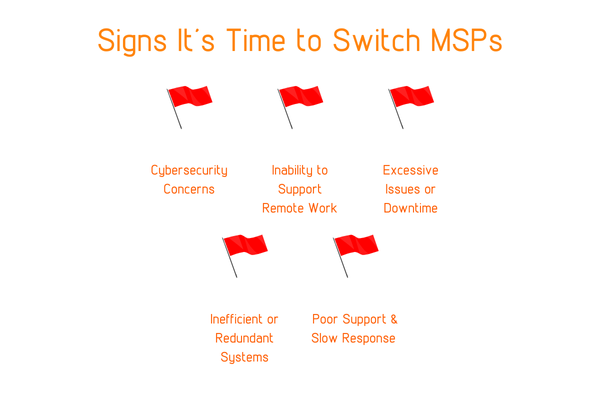
1. Cybersecurity Concerns
Your MSP’s top responsibility is to keep your business secure. If they fail to detect threats, miss critical patches, or can’t explain how they protect your data, that’s a major red flag.
An MSP that can't safeguard your systems is putting your entire business at risk.
2. Inability to Support Remote or Hybrid Work
Today’s professional services teams rely on remote access, cloud tools, and flexible workflows. If your MSP struggles with VPN performance, secure access, collaboration tools, or remote device management, they’re behind the curve.
Your provider should already have hybrid work mastered, not treat it like a new challenge.
3. Excessive IT Issues or Frequent Downtime
Problems happen, but they shouldn't happen constantly. Recurring outages, repeated fixes for the same issue, or long waits for help indicate poor monitoring and weak management.
An effective MSP prevents problems before they escalate, not after they’ve cost you hours or days of productivity.
4. Inefficient or Redundant Systems
Your technology should run lean and smooth. If your MSP keeps layering tools, adding unnecessary software, or complicating basic processes, they’re creating more problems than they solve.
A strong managed IT service provider streamlines operations, eliminates redundancies, and improves performance, not the opposite.
5. Poor Support and Slow Response Times
If you’re dealing with slow ticket responses, vague answers, dismissive interactions, or a lack of transparency, you're not getting what you’re paying for.
Your MSP should feel like a trusted partner, proactive, clear, responsive, and invested in your success.
How to Find the Top Managed Service Providers
Choosing the right MSP is a major decision for any professional services business, whether you're in law, accounting, finance, real estate, or construction. Here’s how to evaluate providers with confidence.
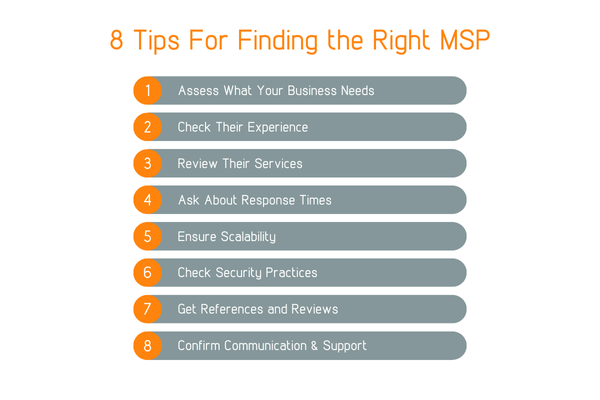
1. Assess Your Business Needs
Identify your current IT gaps, recurring challenges, and long-term goals. The right MSP should align with your needs, not force you into a one-size-fits-all package.
2. Check Their Industry Experience
Look for MSPs with a track record serving professional services firms. Expertise in compliance-heavy, data-sensitive industries is a must.
3. Review Their Service Offerings
Confirm they provide everything you need now (help desk, security, cloud, backups) and what you expect to need as you grow.
4. Ask About Response Times
Fast support isn’t optional. Verify guaranteed SLAs, real 24/7 availability, and escalation procedures.
5. Ensure They Can Scale With You
Your MSP should support new employees, new locations, or rapid expansion without delays, price spikes, or service limitations.
6. Evaluate Their Security Practices
Look for essentials like SOC monitoring, MFA, EDR, SIEM, encryption, and off-site backups. If they hesitate to discuss security, that's a major red flag.
7. Get References and Read Reviews
Honest feedback from current clients reveals what the sales pitch won’t: reliability, service quality, communication, and real-world results.
8. Confirm Their Communication & Support Structure
You should get:
- Clear reporting
- A dedicated account manager
- Proactive updates
- Transparent billing
- No excuses or hiding behind “ticket queues”
Need help cutting through the chaos? Keep reading for some guidance on what to ask.
Questions to Ask a Managed Service Provider
Choosing the right MSP requires more than comparing prices or reviewing certifications.
Ask the right questions to ensure they can meet your current needs and grow with your business.
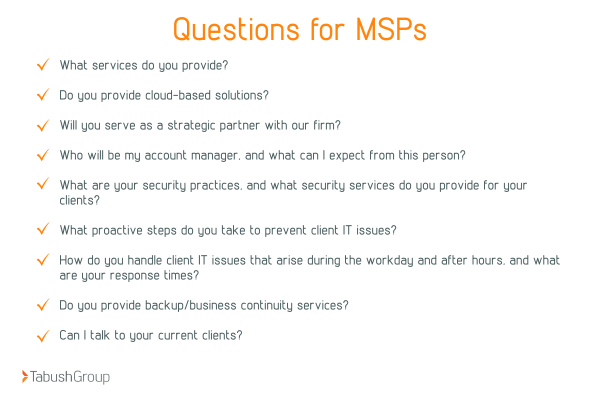
1. Do You Provide the Services We Need?
It’s not enough to cover just the basics. Make sure the MSP offers end-to-end services, including cybersecurity, cloud management, help desk support, network monitoring, and compliance assistance.
Partial solutions can leave critical gaps that put your business at risk.
2. Will You Serve as a Strategic Partner?
You need more than reactive “break-fix” support. The right MSP acts as a strategic partner, advising on technology planning, helping optimize workflows, and aligning IT goals with your business objectives.
This partnership ensures technology drives growth, not just maintenance.
3. Can We Work Securely?
Security is non-negotiable. Ask how the provider meets or exceeds industry compliance standards, protects sensitive client data, and monitors threats in real time.
Your MSP should proactively safeguard your business, not react after a breach occurs.
4. Is Support Available When We Need It?
Downtime can cost your firm thousands of dollars per hour. Confirm 24/7 monitoring and rapid response protocols for critical issues.
An effective MSP ensures that problems are addressed immediately, whether during business hours or off-hours emergencies.
5. Is Your IT Scalable?
Your MSP should grow with your business. Ask how they handle expansion, additional users, or new locations. A scalable provider prevents delays and ensures technology keeps pace with your firm’s growth.
6. Do Your Solutions Support Remote and Hybrid Work?
Modern professional services teams often work from multiple locations or remotely. Verify that the MSP can provide secure access to networks, cloud systems, and applications from anywhere, without sacrificing speed, reliability, or security.
7. Do You Provide Backup and Business Continuity Services?
Disaster recovery planning is essential. Ensure your MSP offers comprehensive backup solutions and business continuity strategies. Without this, a single ransomware attack, hardware failure, or outage could bring your operations to a halt.
Enhance Your Business’s IT With an MSP
By now, you’ve seen how critical managed IT services are, not just for efficiency, but for full protection, long-term stability, and the future of your firm. Whether you’re ready to outsource fully or need a co-managed partner to support your internal team, the right MSP can transform your entire operations.
Is your current IT setup supporting your growth, or silently holding you back? If you’re ready to strengthen your cybersecurity, streamline your technology, eliminate downtime, and get reliable expert support, our team is here to help.
Contact us today to discover how our managed IT services can protect your firm, empower your team, and set you up for long-term success.