Many business leaders find themselves asking, “What are managed IT services, and do I really need them?” It’s no secret that technology plays a critical role in nearly every aspect of your business operations. From cybersecurity and cloud infrastructure to day-to-day technical support, IT systems must be reliable, secure, and scalable. That’s where managed IT services make a major difference.
Read this blog to learn more about what managed IT services are, their benefits, and the types of services it includes.
What Are Managed IT Services?
Managed IT services enable a firm to outsource some or all of its IT functions to a third-party provider, known as a Managed Service Provider (MSP).
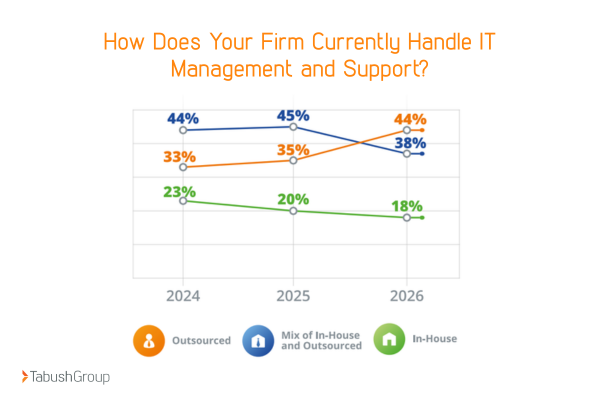
According to our 2026 Survey Report, 81% of firms now outsource IT management in some way, whether fully or with co-managed services.
Managed IT services help a firm to offload the complexity of IT management while gaining access to enterprise-level tools, expertise, and support.
What Are The Benefits of Managed IT Services?
As a business leader, when you partner with an MSP, you will receive a wide range of benefits for your business that go far beyond basic tech support. Here are five benefits of managed IT services.
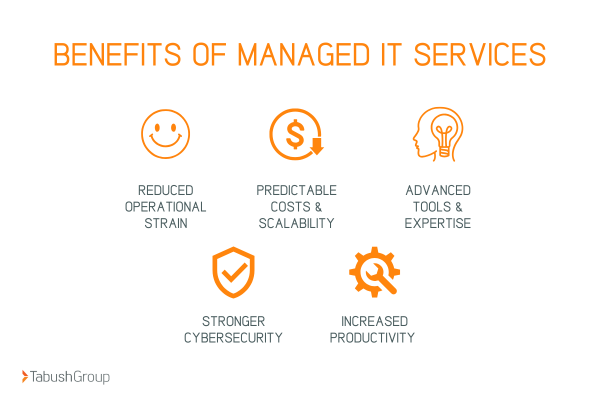
1. Reduced Operational Strain and Free Internal Teams
Managing IT in-house can be time-consuming and distracting, especially when unexpected issues arise. Partnering with a managed service provider (MSP) eliminates IT headaches so you can focus on your own business.
If you also have an in-house IT team, they are freed up to concentrate on higher-level tasks such as strategic initiatives and business-critical projects, while the MSP handles routine maintenance, monitoring, and support.
Let’s break it down further.
-
Routine Maintenance: This involves the proactive patching, updating, and tuning of software and hardware to prevent system failures before they occur.
-
Monitoring: This is the 24/7 automated oversight of your entire network to detect performance dips, security threats, or hardware red flags in real-time.
-
Support: This provides your team with immediate access to technical experts who can troubleshoot and resolve individual user issues or unexpected system glitches.
By offloading these tasks, your team will no longer be bogged down by password resets or server patches. This shifts workload from reactive tasks to proactive growth and gives you more time to focus on the high-level projects that actually move the needle for your business.
2. Predictable Costs and Scalability
One of the biggest benefits of managed IT services is predictable monthly pricing. Most MSPs charge a flat, per-user rate, making it easier to budget and forecast IT expenses without surprise costs.
As your business grows or changes, managed IT services scale with you. Adding new users, opening new offices, or adopting new technologies becomes faster and more cost-effective, without the need to hire additional staff or invest heavily in infrastructure.
3. Advanced Tools and Expertise
MSPs have advanced tools and certifications that are often out of reach for smaller organizations. By partnering with an MSP, your business gains access to IT professionals with expertise in cybersecurity, compliance, networks, and more.
This means you benefit from best practices and emerging technologies without having to build that expertise internally or pay the high price tag.
4. Stronger Cybersecurity
As technology advances, cyber threats become more frequent, sophisticated, and costly. One data breach can cost you about $4.4 million, according to the average reported in the 2025 IBM report.
MSPs implement layered defenses that protect your systems, data, users, and customers.
With constant monitoring and proactive threat detection, MSPs help reduce vulnerabilities, prevent breaches, and ensure your organization stays compliant with industry regulations.
5. Increased Productivity
Downtime and slow systems directly impact your employees’ productivity and can cost you money. In fact, the average cost of downtime is about $9,000 per minute.
MSPs use proactive monitoring to identify and resolve issues before they disrupt operations.
With faster response times, fewer outages, and reliable systems, your team can work more efficiently and with less frustration. With them working more productively, they can also improve client satisfaction.
What Services Do MSPs Offer?
MSPs can handle your entire IT, one specific IT service, or something in between. Depending on your needs, an MSP can function as a virtual chief technology officer, working closely with you and your team to strategically develop innovative solutions to meet your specific business objectives.
Businesses can typically choose from a menu of services and easily scale up or down as their needs evolve.
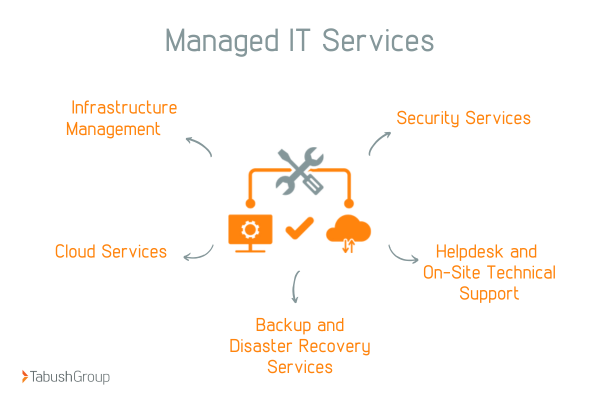
1. Infrastructure Management
An MSP can manage your IT infrastructure, which can be thought of as the roads and bridges on which your applications run. MSPs administer, support, and monitor your networks, servers, PCs, and endpoints to ensure optimal performance and security.
They expertly and rapidly respond to issues that arise to minimize downtime and proactively prevent problems from developing.
2. Security Services
MSPs have the resources and expertise to offer more comprehensive cybersecurity than most small and midsize businesses can manage on their own.
A good MSP will place a strong emphasis on defensive measures and offer multilayered security features, including:
-
24x7x365 monitoring
-
Audits
-
Protective software
-
Patch and security updates
-
Strong passwords
-
Security education and training for your staff
MSPs also upgrade software as updates become available, ensuring you are always working on the most current version of applications.
3. Cloud Services
Nearly every business uses cloud-based solutions for some or all of their IT needs. Many MSPs offer managed cloud services that deliver secure, remote access to systems, applications, and data without the need for on-premises hardware.
There are several categories of cloud-based solutions, like Desktop as a Service (DaaS), which allows you to access your desktops and entire suite of applications from anywhere using any internet-connected device.
4. Helpdesk and On-Site Technical Support
End-user support is a key operational priority for most organizations, as employee productivity depends directly on reliable technology. One of the core offerings of MSPs is support services, in which a team of trained experts solves your employees’ technical issues in a timely fashion.
Support may include services like proactive monitoring, helpdesk, remote support, maintenance, network management, and patch management.
Some MSPs offer on-site IT services, including dispatching technicians to your location to repair equipment, install hardware, or handle special projects.
5. Backup and Disaster Recovery Services
MSPs can ensure all of your data and files are regularly backed up and safely stored in more than one location.
In the event of a power outage or a disaster such as a flood or fire at your offices, MSPs are experts in providing timely access to critical databases, specific files, and entire systems to minimize downtime and ensure business continuity.
Leverage Managed IT Services
Managed IT services provide businesses with reliable technology, stronger security, predictable costs, and peace of mind. Whether you’re looking to fully outsource IT or enhance your existing capabilities, the right MSP can transform technology from a burden into a strategic advantage.
Tabush Group is a leading provider of managed IT services, including our Edge, co-managed IT services. With our Guardian Security Operations Centers as A Service (SOCaaS) 24x7x365 monitoring and detection, and multi-layered security suite, we keep your IT and operations running smoothly.
To learn more about how our state-of-the-art IT solutions can make your firm’s operations more efficient and secure, contact us.