Most firms compare co-managed IT providers on price and services. But the details that often decide whether the partnership works can be easy to overlook: who your point of contact is, what happens to a problem raised after business hours, and what happens to your data if you leave. Here are seven things to evaluate, and the questions to ask on the call for each one.
This post works through each one and gives you the question to ask. If you are still deciding whether the model itself fits your firm, start with our page on co-managed IT services (link: /edge-co-managed-it-services), which sets out how the shared model works and where the line sits between your team and the provider.
What to check before choosing a provider:
-
A named client manager
-
Services you can select individually rather than a fixed bundle
-
Reporting on a set schedule, with metrics you agreed in advance
-
A documented process for monitoring and work outside business hours
-
Direct experience with firms in your industry and the applications you run
-
An agreement that states scope and response commitments
-
Written exit and handover terms
Co-Managed IT At A Glance
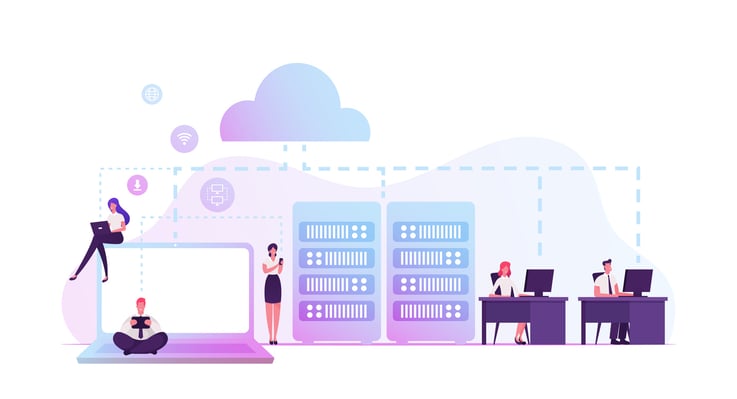
Co-managed IT services involve a collaborative partnership between your in-house IT team and an external managed service provider (MSP).
Your internal lead keeps ownership of business systems, end-user relationships and firm-level decisions; the provider takes the operational layers that are hard to staff around the clock.
If you are weighing the two outsourcing models against each other rather than picking a provider, managed IT vs co-managed IT puts them side by side.
What Your Internal IT Team Gains From Co-Managed IT
Co-managed IT services offer a strategic partnership between your internal IT team and a managed service provider, enabling your business to operate more effectively and securely.
Here are a few ways a co-managed IT service provider can benefit your business.
Fill Gaps
No IT team can excel in every area. Whether it's due to limited resources, expertise, or time, gaps in your IT coverage can lead to vulnerabilities. ISC2's 2024 Cybersecurity Workforce Study found that 90% of respondents report one or more skills gaps on their cybersecurity team, and that budget, not headcount alone, is the number one cause.
Co-managed IT services help fill these gaps by providing:
- Specialized Expertise: Gain access to experts in areas like cloud computing, compliance, or advanced cybersecurity that may be outside your team’s skill set.
- Scalable Resources: Meet fluctuating demands, such as project-based needs or seasonal spikes, without overburdening your team.
- Advanced Tools: Leverage cutting-edge technology and software that may otherwise be expensive or challenging to manage in-house.
Ensure Business Continuity
Unexpected disruptions like cyberattacks, hardware failures, or natural disasters can be devastating. Co-managed IT services provide proactive solutions to ensure your business keeps running, such as:
- Disaster Recovery Plans: Comprehensive strategies to restore critical systems and data with minimal downtime.
- Proactive Maintenance and Patch Management: Regular updates, patches, and system health checks to prevent failures before they occur.
- 24x7x365 Monitoring: Continuous monitoring ensures potential threats or issues are identified and resolved before they impact your operations.
Enhance Cybersecurity
Cyber threats are constantly evolving, and protecting your business requires more than just basic antivirus software. Co-managed IT services enhance your cybersecurity through:
- Threat Detection and Response: Advanced tools that identify and neutralize threats in real-time.
- Evidence for your compliance work: logging, reporting, and documented security controls your team can put in front of auditors, insurers, and clients. Your firm still owns the compliance obligation itself.
- Employee Training: Ongoing education for your staff to recognize phishing attempts, malware, and other cyber risks.
Support Outside Business Hours
IT issues don’t follow a 9-to-5 schedule. Monitoring runs continuously, and business-critical issues get attention outside office hours. Co-managed IT services provide:
- Day-to-Day and After-Hours Support: Daily support for routine issues during regular hours, with after-hours assistance available for business-critical issues
- 24x7x365 Monitoring: Real-time alerts and rapid response to minimize downtime and disruption.

Reduce Employee Burnout
IT professionals often juggle multiple responsibilities, leading to stress, errors, and even turnover. In the same ISC2 study, more than half of respondents said they do not have enough time to learn new skills.
Co-managed IT services ease the burden by:
- Sharing Workloads: Offloading routine tasks like system updates, patch management, or password resets.
- Allowing Focus on Strategic Tasks: Freeing up your team to work on high-value projects that drive business growth.
- Preventing Burnout: Ensuring your team is not overstretched during critical times, such as migrations or large deployments.
Optimize Efficiency
Efficient IT operations are essential for maintaining a competitive advantage and meeting customer expectations. Co-managed IT services enhance efficiency by:
- Removing Duplicated Work: Cutting redundant steps and automating repetitive tasks so the same job is not done twice.
- Customizing Solutions: Tailored services that align with your unique business needs, reducing wasted effort.
- Providing Strategic Insights: Access to IT consultants who can help you plan and execute initiatives that support long-term goals.
7 Things to Check Before You Sign
Not every IT services provider is the same. Selecting the right co-managed IT service provider is a critical decision that can significantly impact your business’s IT performance and overall success.
A reliable provider will complement your internal IT team, offering flexibility in services and strategies to enhance efficiency and security. Here are the key factors you should consider when making your choice.
1. A Dedicated Client Manager
Don’t get lost in a sea of other clients. Check that you will have an assigned client manager who acts as your virtual CTO. This person should be available to work with your leadership to formulate a strategic technology plan.
They should host quarterly meetings where your vCTO will review progress and ensure continued strategic alignment with your business needs.
Ask: Who is my client manager by name, how often do we meet, and who covers that role when they are away?
2. Flexibility
Your co-managed IT services should be customizable, allowing you to choose the services your company needs. Having flexibility ensures your IT services are cost-effective, efficient, and scalable as your needs evolve.
Ask: Can I take a single service line without buying the rest, and what happens if I want to drop one at renewal?
3. Reporting You Actually Receive
Your co-managed IT services provider should give you comprehensive reporting with metrics and insight into your IT systems and infrastructure.
Ask: Show me a real client report with the names removed, and tell me how often it is provided.
4. A Proactive Approach
Another thing to look out for is processes that show they are proactive. They should have regular monitoring and maintenance to keep an eye out for problems and take immediate action outside of business hours.
This ensures your company’s security and productivity are not impacted.
Ask: Walk me through what happens to an alert raised at 9 p.m. on a Friday, from detection to the point my team is involved.
5. Expertise In Your Industry
Every industry, from law firms to accounting firms, has unique IT needs, from compliance requirements to specialized tools and workflows. Partnering with a provider that has experience in your industry ensures they can understand your unique challenges and provide industry-specific solutions.
Ask: Name three firms like mine you support, and tell me which of my core applications you have run before. For law firms in particular, that means document management such as iManage or NetDocuments, e-filing, and confidentiality obligations. Our post on co-managed IT for law firms covers what that looks like in practice.
6. What The Agreement Commits Them To
A co-managed agreement is priced per service line, so the commitments differ line by line. Read what response times attach to monitoring, to patching, to threat detection and to end-user requests, and check whether those are commitments or targets. Check which of your systems are in scope and which are explicitly out. Check who is responsible when a third-party vendor is the cause.
Ask: Which parts of my environment are out of scope, and what is the response commitment on each service I am buying?
7. How You Get Your Environment Back
Before you move forward, establish that documentation, credentials, monitoring configuration, and historical reporting belong to you and are handed over on request. Read the notice period. Find out whether tooling licenses transfer to you or simply terminate.
Ask: If I give notice, what do I receive, in what format, and how long does the handover take?
Where Tabush Group Fits
At Tabush Group, we specialize in bridging the gap between in-house IT teams and the growing demands of modern businesses. Our Edge Co-Managed IT Services provide the tools, expertise, and 4x7x365 monitoring and after-hours coverage for business-critical issues your business needs to thrive.
With our help, your IT team can focus on fundamental operations while we pick up the operational layers that are hard to staff around the clock: infrastructure monitoring, patch management, managed detection and response through Guardian SOCaaS, and Microsoft 365 governance. Our proven processes are built around reliable, secure, and scalable IT infrastructure that supports your business objectives.
If you want to see what this looks like in your own environment, a 360 IT Assessment reviews your current setup and identifies where the gaps are. It is an independent review; it is not a proposal for our services.
FAQs
What should I ask a co-managed IT provider before choosing?
Start with the two that reveal the most: what happens to an alert raised at 9 p.m. on a Friday, and what you receive if you give notice. The full list of seven checks, with the question to ask on each, is set out above.
How is a co-managed IT provider different from a fully managed one?
A co-managed provider works alongside an IT team you already have and shares responsibility with them. A fully managed provider runs the IT function end to end for firms with no internal IT staff. The comparison is set out in full in the managed IT vs co-managed IT post linked above.
Can a small internal IT team work with a co-managed provider without losing control?
Yes. In a co-managed arrangement, the internal IT lead stays the decision-maker and keeps visibility through shared dashboards, ticketing and reporting. The provider covers the operational layers and after-hours load rather than taking over the function.