
An AI acceptable use policy sets rules for which artificial intelligence (AI) tools a law firm can use, what information staff may enter, who reviews AI-generated outputs, and who oversees AI adoption.
Law firms are already using AI in their daily operations, from reviewing documents to organizing legal research. But many firms are still developing the policies and training needed to manage AI use and address potential security risks.
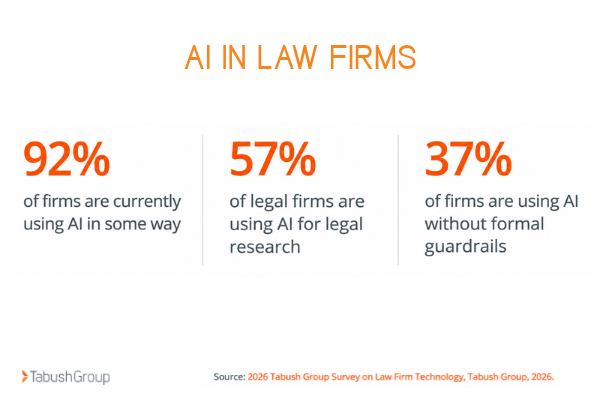
According to Tabush Group's 2026 Law Firm Technology Survey, 92% of responding firms use AI, while only 41% invest in AI training. The survey included more than 230 law firm leaders.
These findings highlight the importance of establishing clear expectations for AI use across the organization. This guide explains AI governance best practices for law firms, what to include in an acceptable use policy, and how to implement a practical framework for ongoing oversight.
What Is AI Governance For A Law Firm?
AI governance is the policies, processes, and oversight a law firm establishes to guide how AI tools are used across the organization.
The policy should establish consistent rules for approved AI tools, client confidentiality, data handling, acceptable uses, and the review of AI-generated work.
All employees, including attorneys, administrators, leadership, and IT staff, must follow the same firmwide AI acceptable use policy. While everyone follows the same rules, leadership and designated IT personnel may be responsible for implementing the policy, evaluating tools, providing training, and monitoring AI usage.
Consistent rules help employees understand what is permitted, what requires approval, and how to use AI responsibly.
For additional context on AI adoption in legal practices, read How Law Firms Can Adapt to the AI Revolution.
Who Should Own AI Policy Decisions At a Law Firm?
A cross-functional AI leadership team within your firm should own AI governance.
The team should:
-
Establish executive support
-
Create your AI policy
-
Standardize approved tools and initiatives
-
Review new AI requests, integrations, and use cases
An AI leadership team should bring together the individuals responsible for legal, operational, and technical decisions. Each member should have defined responsibilities to support consistent AI governance across the firm.
|
Role |
Responsibility |
|
Managing partner or executive sponsor |
Establishes priorities, approves resources, and supports firmwide adoption |
|
Legal or ethics reviewer |
Reviews professional obligations, client confidentiality requirements, and disclosure considerations |
|
IT and security owner |
Evaluates AI tools, manages permissions, and reviews security controls |
|
Practice-area representatives |
Identify relevant use cases, communicate employee needs, and provide feedback |
Smaller firms may assign multiple responsibilities to the same individual, provided each function has a clearly identified owner.
Tabush Group partners with law firms to establish their AI Leadership Team, facilitate quarterly meetings, and provide ongoing guidance on AI governance, security, and implementation.
For firms that need additional technology support, working with a partner experienced in managed IT services for law firms can help coordinate technical controls with existing operations.
What Should A Law Firm’s AI Acceptable Use Policy Include?
A law firm AI acceptable use policy should address eight essential areas: purpose and scope, approved tools, permitted uses, client confidentiality, human review, professional obligations, incident reporting, and ongoing oversight.
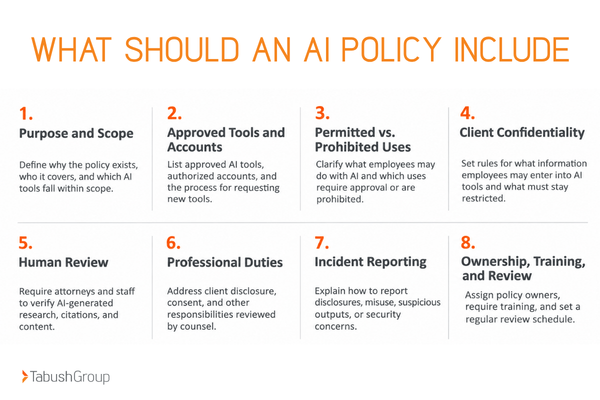
Each area should include clear instructions employees must follow during their daily work.
1. Purpose and Scope
Every policy needs an explanation of why it exists, who it applies to, and what type of technology falls within its scope. The policy should include AI tools such as ChatGPT and Claude, as well as integrated AI features in Microsoft 365 and other applications used by the firm.
2. Approved Tools and Accounts
Maintain an active list of approved AI tools, authorized accounts, and permitted configurations. Employees should know how to request approval for new tools, and the firm’s cross-functional leadership team should evaluate vendor terms, data access, and retention practices before approval.
3. Permitted vs Prohibited Use Cases
Define when employees can use AI tools and which require additional authorization.
For example, a firm may allow AI to assist with internal brainstorming or formatting documents while requiring approval for legal research or drafting client-facing materials.
The policy should identify any prohibited activities, such as entering confidential client information into AI tools.
4. Client Confidentiality and Input Restrictions
Your policies should make it clear what information employees can enter into AI and what is restricted.
Some items that require particular attention include:
-
Client records
-
Privileged communications
-
Personally identifiable information
-
Financial details
-
Confidential case materials
Before approving a tool, firms should evaluate its data retention, sharing, and model-training practices. The Florida Bar's Ethics Opinion 24-1 discusses considerations involving generative AI and client confidentiality.
5. Attorney Verification and Human Review
Any AI-generated legal research, citations, documents, and recommendations need clear requirements for review.
Attorneys should:
-
Verify legal authorities against reliable primary sources
-
Check factual statement
-
Confirm that AI-generated content accurately reflects the relevant jurisdiction and circumstances.
Responsibility for legal work remains with the supervising attorney.
6. Client Disclosure and Applicable Professional Duties
The policy should detail when AI may require client notification, consent, or when it needs additional review.
The American Bar Association's Formal Opinion 512 addresses ethical responsibilities involving generative AI, including competence, confidentiality, communication, and supervision.
Your counsel should review applicable professional obligations and determine how they affect internal policy requirements.
7. Incident Reporting and Escalation
Provide clear instructions for reporting accidental disclosures, unauthorized AI usage, suspicious outputs, or potential security incidents.
Employees should know whom to contact, what information to preserve, and when to report concerns. Your cross-functional team should evaluate incidents and coordinate response appropriately.
8. Policy Owner, Training, and Review Dates
Finally, assign responsibility for maintaining the policy, coordinating employee training, and reviewing the list of approved AI applications to your cross-functional AI leadership team.
The policy should include an effective date, employee acknowledgment requirements, and a review schedule. Reviewing everything quarterly allows you to evaluate new AI capabilities, changes in vendor practices, and employee feedback.
Example of AI Acceptable Use Policy Guidelines
The following examples illustrate how a law firm could categorize AI activities. Actual permissions should reflect the firm's approved tools, information restrictions, and professional obligations.
|
AI activity |
Example |
Policy guidance |
|
Allowed |
Brainstorming internal meeting agendas using nonconfidential information |
Permitted with approved tools |
|
Approval required |
Using AI to summarize case documents |
Requires authorization and appropriate controls |
|
Prohibited |
Uploading privileged client communications to an unapproved public AI tool |
Not permitted |
These examples give employees a practical reference for determining when they can proceed and when additional approval is necessary.
How To Put AI Governance Best Practices Into Action
Implementing AI governance requires a structured process for identifying existing tools, approving new applications, training employees, and monitoring usage.
The following steps can help law firms put their AI acceptable use policy into practice.
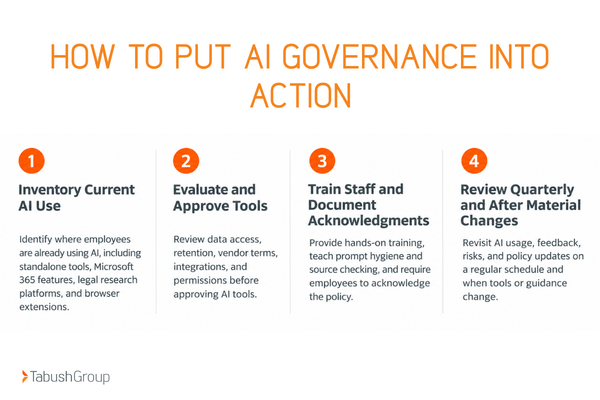
Inventory Current AI Use
Start by identifying where employees are already using AI. Include standalone AI applications, AI features embedded in Microsoft 365, legal research platforms, and browser extensions.
Document which tools are in use, who has access, and what information they process. This inventory helps the firm identify potential risks and determine which tools require further evaluation.
Evaluate and Approve Tools
Establish an approval process before implementing AI applications. Assign an owner to review data access, retention, vendor terms, integrations, and permissions.
For example, AI features within Microsoft 365 may access information based on existing user permissions and product configurations. Before expanding AI usage, firms should review employee access, sensitive file locations, and whether existing permissions provide appropriate restrictions.
The NIST Generative AI Risk Management Profile offers a voluntary framework for evaluating and managing generative AI risks.
Train Staff and Document Acknowledgments
Your employees need hands-on training to understand how to use approved AI tools appropriately and safely.
Training should teach:
-
AI capabilities and risks
-
Prompt hygiene
-
Refining responses
-
Source checking
-
Applying AI to business scenarios
-
Using AI securely
-
Escalation
Require employees to acknowledge that they have reviewed and understand the firm's AI acceptable use policy. Document training completion and provide updated guidance when new tools or policy requirements are introduced.
AI training should continue as tools evolve and new use cases emerge. Tabush Group's AI Fundamentals Training helps employees develop practical skills for using approved AI tools, writing effective prompts, and verifying AI-generated results.
Review Quarterly and After Material Changes
Conduct quarterly meetings with your firm’s AI Leadership Team to review usage, employee feedback, security concerns, and any new AI requests.
Review and revise the policy when a new AI integration is added to your platforms, vendor practices change, or revised professional guidance.
Conduct periodic assessments of AI usage, data access, and security controls to identify potential risks and areas requiring additional oversight.
How FoundationAI Supports Ongoing AI Governance
Developing an AI acceptable use policy is an important starting point. Law firms also need a practical approach to evaluating their technology environment, educating employees, and maintaining oversight as AI usage expands.
Taush Group’s AI implementation services help law firms develop a structured approach to AI adoption through assessments, governance, employee training, and implementation support.
FoundationAI includes:
-
AI Leadership Team: Helps establish a cross-functional team and meets to advise on any policy development.
-
AI Fundamentals Training: Provides training for ChatGPT, Microsoft Copilot, or Claude, including prompting, verification, and security.
-
AI Oversight: Evaluates AI usage, governance practices, and security controls to identify potential risks as adoption expands.
-
AI Implementation: Supports the integration of AI solutions with the firm's existing IT infrastructure and the implementation of additional security controls.
Firm leadership retains responsibility for organizational decisions, while the firm's counsel reviews applicable legal and professional obligations.
Establish Clear AI Guidelines for Your Law Firm
An effective AI acceptable use policy helps law firms establish consistent guidelines for evaluating technology, handling sensitive information, and reviewing AI-generated work. Firms should begin by identifying current AI usage, defining approved applications, assigning responsibilities, training employees, and establishing a regular review schedule.
Explore FoundationAI to help your firm establish practical AI governance and a plan for responsible adoption.
FAQs
What is an AI acceptable use policy for a law firm?
An AI acceptable use policy is a set of rules defining how attorneys and staff may use artificial intelligence. It identifies approved applications, permitted activities, confidentiality requirements, human review responsibilities, and procedures for reporting concerns.
What information should law firms avoid entering into AI tools?
Law firms should restrict confidential client information, privileged communications, personal identifiers, financial records, and sensitive case materials according to their policies. Any use of such information requires appropriate authorization, approved tools, and an evaluation of the application's data handling practices.
Who is responsible for reviewing AI-generated legal work?
The responsible attorney must review and verify AI-generated legal work before relying on it. This includes checking citations, legal authorities, factual statements, and jurisdiction-specific requirements. AI tools do not replace an attorney's professional judgment or supervisory responsibilities.
How often should a law firm review its AI policy?
Law firms should establish a regular review schedule, with quarterly reviews serving as a practical starting point. Additional reviews may be necessary when introducing new AI tools, changing security configurations, receiving updated professional guidance, or identifying significant usage concerns.