Technology has become an essential part of law firms' daily operations, from managing case files to securing confidential client data.
However, with these advancements come significant challenges—cybersecurity threats, cloud management complexities, and compliance hurdles, among others. Firms that fail to address these risks may face inefficiencies, security breaches, and client loss.
In this blog, we’ll explore the top technology challenges law firms encounter and strategies to overcome them.
The data below has been updated to reflect findings from the 2026 Tabush Group Survey on Law Firm Technology, drawn from responses by more than 230 Managing Partners, Firm Administrators, and IT leaders.
Benefits of IT for Law Firms
Investing in technology is no longer optional for law firms—it’s a necessity. IT solutions provide:
- Enhanced security – Protect sensitive client data from cyber threats
- Improved efficiency – Automate routine tasks, freeing up billable hours
- Seamless collaboration – Enable teams to work remotely and securely
- Better compliance – Stay on top of evolving regulations
- Business continuity – Ensure uninterrupted operations in case of disruptions
However, technology without proper training or expertise can bring about a number of challenges.
Common Technology Challenges
Every big change comes with its challenges when not fully prepared. Equipping your team with the right solutions and training can turn a technology challenge into an opportunity to set yourself apart from your competitors.
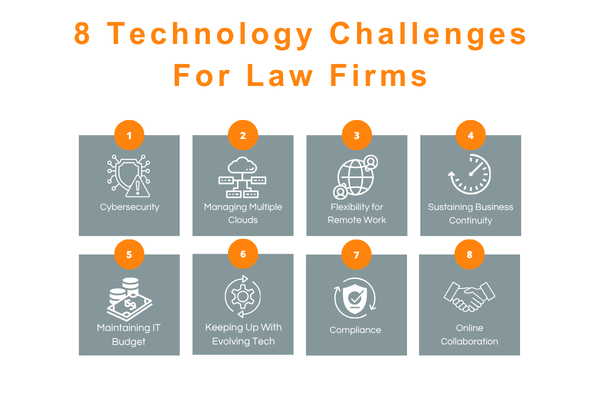
1. Cybersecurity
Law firms are prime targets for cybercrime due to the vast amount of confidential client data they handle. Cybercriminals are increasingly launching sophisticated attacks, ranging from phishing scams to brute-force attacks and insider threats.
In our 2026 Survey on Law Firm Technology, reported data breaches and exfiltration incidents more than doubled, rising from 6% in 2025 to 13% in 2026, even as firm-leader confidence in cybersecurity measures rose from 88% to 91%. That gap between confidence and outcomes is the real warning.
A single cybersecurity breach can have devastating consequences, including financial losses, legal liabilities, and irreparable damage to a firm’s reputation. Additionally, failing to protect client data can result in regulatory penalties and lawsuits.
The Solution:
Implement an advanced cybersecurity suite that includes multi-factor authentication (MFA), encryption, 24/7 monitoring, regular cybersecurity audits, and much more. Educate employees on phishing scams and social engineering tactics.
Invest in managed IT services for law firms to proactively monitor and respond to threats.
2. Managing Multiple Clouds
Many law firms rely on cloud-based tools like Google Drive, Microsoft 365, Dropbox, and private servers for document storage and case management. However, using multiple cloud platforms without a cohesive strategy and proper integration can create data silos, security risks, and inefficiencies.
Key challenges:
- Lack of centralized access control can result in data fragmentation and duplication
- Inconsistent security measures across platforms increase cyber risks
- Inefficiencies in collaboration slow down case processing
Don’t worry—this doesn’t mean you have to abandon your cloud solutions; you just need the right strategy.
The Solution:
Use a centralized cloud management platform to manage your multiple clouds, ensuring your systems and data are accessible and efficient.
Establish access controls and backup strategies to prevent data loss. If you lack the internal resources, you can choose a cloud or managed IT service provider with legal industry compliance certifications to support you.
3. Flexibility for Remote Work
Hybrid and remote work models are now a standard practice for many law firms. However, without the right infrastructure, remote work can have its challenges.
- Employees using unsecured networks can expose sensitive case files
- Slow or inefficient access to documents hampers efficiency
- Poorly protected devices become easy entry points for cybercriminals
Client data leaks, productivity issues, or security vulnerabilities could result in significant financial losses and client attrition for your firm.

The Solution
Invest in a Desktop as a Service (DaaS) solution that provides secure access to all of your files and apps from anywhere on any device. The right solutions come fully equipped with security for peace of mind with remote workers.
Additionally, firms should deploy endpoint security solutions to protect employee devices, ensuring that remote workers are using secure networks and company-approved hardware.
4. Sustaining Business Continuity
Unexpected disruptions like cyberattacks, IT failures, or natural disasters can bring law firm operations to a standstill. Downtime leads to financial loss, missed deadlines, and client distrust.
Every hour of downtime can cost law firms thousands of dollars in lost billable hours.
The Solution
Deploy cloud storage and backup generators for critical systems, regularly test your backup systems, and conduct IT drills.
Even with the most reliable storage solutions, you will also need to implement disaster recovery (DR), business continuity, and cyber breach response plans.
5. Maintaining IT Budget
IT expenses can quickly spiral out of control if law firms overpay for redundant or outdated technology. Investing in inefficient systems wastes resources and adds unnecessary complexity.
Are you paying for tech that isn’t serving your firm’s needs?
Our 2026 survey found that 70% of law firms now cite productivity as the primary driver of IT investment (up from 66% in 2025). Productivity is a defensible budget priority, but only when the firm can see what each line item is actually delivering.
The Solution
Conduct an IT assessment to eliminate inefficiencies. Then, opt for scalable solutions that grow with your firm’s needs.
Additionally, using a managed service provider (MSP) helps with predictable IT costs and proactive support. Firms with strong in-house IT that need depth in specific areas, like 24/7 monitoring or after-hours coverage, can also use Edge Co-Managed IT Services to extend the team without giving up day-to-day control.
6. Keeping Up With Evolving Tech
The legal industry is being transformed by AI, automation, and advanced legal tech. Firms that fail to adapt risk falling behind competitors who leverage these technologies for efficiency, accuracy, and client service.
Key trends driving legal tech:
- AI-powered legal research reduces case preparation time by hours
- Automation tools streamline contract review and document generation
- Cloud-based litigation support enhances collaboration across teams
According to our 2026 Survey on Law Firm Technology, AI adoption has reached 92% of firms in 2026, with legal research the top use case at 57% implementation. However, only 41% of firms are investing in AI training for the attorneys and staff using these tools, creating a serious gap between adoption and responsible use.
The Solution
The best way to keep a competitive edge is to stay updated on legal tech trends. Invest in AI-powered research tools and automation for document review.
Assign a tech committee within your firm to evaluate, implement, and create policies governing emerging technologies. Pair adoption with structured AI training so attorneys and staff can use these tools responsibly under ABA Model Rule 1.1 (Comment 8) technological competence obligations. If you do not have the resources, you can leverage a managed IT service provider.
7. Compliance
Law firms handle highly sensitive client data, making compliance with ABA, GDPR, HIPAA, and other regulations essential. Failure to comply can lead to hefty fines, lawsuits, and reputation damage.
Common compliance technology challenges:
- Keeping up with evolving data privacy laws
- Ensuring client data encryption and secure storage
- Maintaining audit trails for legal documentation
The Solution
A proactive approach to compliance includes implementing compliance tracking software that automates regulatory updates and firm-wide adherence.
Training employees on data protection regulations ensures that all staff members understand their responsibilities.
Conducting annual IT compliance assessments helps identify gaps and prevent potential violations before they become legal issues.
8. Online Collaboration
Today’s clients expect seamless digital interactions with their legal teams. When communication breaks down, so does client satisfaction.
Additionally, poor internal online communication leads to delays, inefficiencies, and frustration.

The Solution
Enhancing client collaboration starts with implementing secure client portals that allow for confidential case updates, document sharing, and real-time messaging.
Automating scheduling with integrated calendar tools eliminates unnecessary back-and-forth emails, streamlining client-attorney communication.
Overcome Challenges with Cloud & IT Solutions
The legal industry is undergoing a digital transformation, but without a strategic IT approach, firms risk security vulnerabilities, inefficiencies, and compliance failures.
Proactively addressing these challenges ensures smoother operations, better data protection, and a competitive edge.
If your firm needs expert guidance, consider a 360 IT Assessment to strengthen your infrastructure and future-proof your practice. From there, you can determine if your firm needs cloud solutions or managed IT services tailored to law firms.
Want the Full Picture For Your Firm?
Download the 2026 Tabush Group Survey on Law Firm Technology for the full data set, including how peer firms are sizing IT teams, allocating security spend, and approaching AI adoption.
Frequently Asked Questions
What are the biggest technology challenges facing law firms in 2026?
The biggest technology challenges facing law firms in 2026 are cybersecurity (with breach incidence more than doubling from 6% to 13% year over year), AI adoption without training (92% of firms now use AI but only 41% invest in AI training), multi-cloud sprawl, remote-work security, business continuity, IT budget control, compliance with evolving regulations, and online collaboration. The 2026 Tabush Group Survey on Law Firm Technology confirms these as the top reported concerns from more than 230 firm leaders.
How do law firms protect against cyberattacks?
Effective law firm cyber defense combines layered tools (multi-factor authentication, endpoint detection and response, 24/7 monitoring, encrypted communications) with ongoing user awareness training. Most firms work with a managed IT partner experienced in law firms to handle the depth and after-hours coverage their in-house teams cannot reasonably staff.
Should a law firm use a managed IT service provider or hire in-house IT?
It depends on the firm's size, complexity, and existing IT staff. Firms without internal IT typically go fully managed. Firms with a strong in-house IT person who need to extend their reach into specialized areas (24/7 SOC, M365 governance, after-hours coverage) often choose co-managed IT through Edge, which keeps the in-house lead in their role while the provider supplies tools, depth, and coverage.
What is co-managed IT for law firms?
Co-managed IT for law firms is a partnership where an external provider works alongside the firm's in-house IT team to fill specific gaps, typically 24/7 security monitoring, after-hours help desk, Microsoft 365 governance, and project-surge capacity. The internal team keeps control of day-to-day operations while the provider supplies tools, expertise, and coverage. According to the 2026 Tabush Group Survey, 38% of firms now use a co-managed IT model.
How often should a law firm assess its IT?
Tabush Group recommends a structured360 IT Assessment every 1 to 3 years, depending on firm size, risk exposure, and how much the technology or business environment has changed since the last review. Between assessments, cybersecurity threats evolve quarterly and legal technology shifts every month.