Hiring someone new can be time-consuming and costly. It’s easy to delay expanding your team, especially if your firm isn’t experiencing rapid growth or managing a large client base.
However, while relying on an in-house IT department may feel efficient, there comes a point where it can limit your firm’s growth. As cyber threats evolve and your firm scales, your internal team may struggle to keep up.
Here are a few signs that your firm has outgrown its IT department.
Key Takeaways
-
Reactive IT is a red flag — If your team is constantly putting out fires, there’s little time left for strategy, upgrades, or long-term improvements.
-
One or two IT staff can’t do it all — Modern IT requires specialized expertise that most in-house teams simply can’t cover effectively.
-
Technology should support growth, not slow it down — Misalignment between IT and business goals leads to inefficiencies, risks, and missed opportunities.
-
Co-managed IT offers a scalable solution — Gain access to advanced tools, 24/7 support, and expert guidance without replacing your internal team.
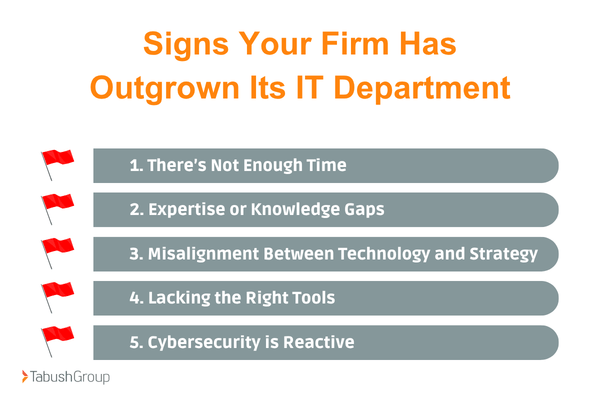
1. Not Enough Time
Does it feel like your IT staff spends most of their time handling day-to-day issues like responding to help desk tickets or putting out fires?
That leaves little time remaining for upgrades, strategic planning, or long-term improvements. When your IT team is stretched too thin and is overworked, it increases the likelihood that important issues will fall through the cracks.
According to OnePoll, more than half of IT workers (58%) say they’re overwhelmed by their daily tasks, with the average IT worker reporting they can only support about 85% of the tickets they receive.
Not only is this an inconvenience to your staff, but it can also have other repercussions, like growing gaps in your security or infrastructure that become outdated or unstable.
2. Expertise or Knowledge Gaps
Modern IT requires specialized skills across cybersecurity, cloud systems, AI, network management, integrations, and more.
It’s unrealistic to expect a small team to cover all of these areas effectively. These knowledge gaps can ultimately lead to costly mistakes, inefficiencies, or missed opportunities.
If your team frequently encounters challenges beyond their expertise, such as cloud migrations or complex software integrations, relying on quick online solutions simply isn’t enough.
3. Misalignment Between Technology and Strategic Initiatives
Whether you’re planning to scale now or in the future, adding attorneys, staff, or new locations, your technology needs to grow with you.
Too often, internal IT teams are forced to prioritize immediate operational needs over long-term strategy. Without proper planning, technology decisions become reactive rather than proactive, only addressed when something breaks or becomes urgent.
Strategic alignment ensures your technology supports your firm’s growth, rather than holding it back.
4. Lacking the Right Tools
Outdated infrastructure and limited monitoring tools can significantly slow down your operations.
Processes that could be automated remain manual, network visibility is restricted, and legacy systems linger far longer than they should. Smaller IT teams often lack access to enterprise-level tools that enable efficiency, automation, insight, and proactive management.
While these limitations may not cause immediate disruption, they can gradually lead to larger issues, ranging from system failures to lost clients or security breaches.
5. Cybersecurity is Reactive
Firms handle sensitive client data, which makes them frequent targets for cyberattacks. Issues such as phishing, ransomware, and email compromise keep developing and becoming more complex.
According to Tabush Group’s 2026 Survey on Law Firm Technology, Phishing remains the #1 threat, with 60% of firm respondents experiencing phishing attacks, while 27% of firm leaders cite having been hit with ransomware.
These threats require your team to continuously monitor, test, and manage your IT. If your firm’s security measures tend to improve only after an incident occurs, it’s a strong indicator that your current IT support may not be sufficient.
When your team only knows there is an issue when it's too late, you will experience a lot of downtime, and according to Gratner, the average cost of IT downtime is $5,600 per minute.
Not Ready to Fully Outsource? Why Co-Managed IT May Be the Ideal Solution
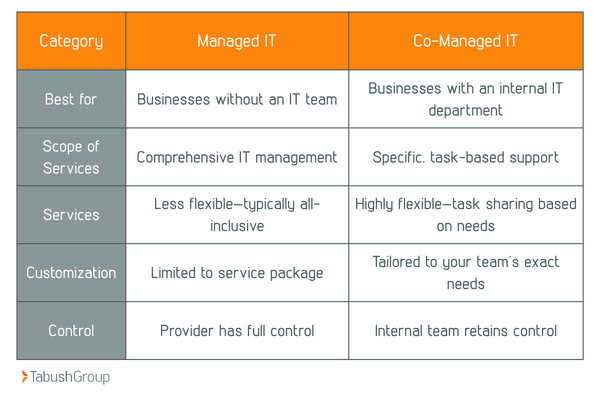
If you notice any of the signs listed above, don’t worry, there is a solution. Outsourcing your IT. But that doesn’t mean you have to outsource everything. An emerging trend is firms leveraging co-managed IT services to enhance their existing internal IT team.
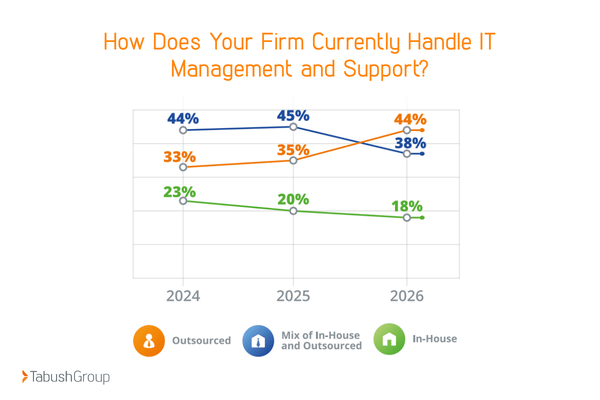
According to our 2026 Law Firm Technology Survey, in just two years, outsourced IT models jumped from 33% (2024) to 44% (2026), an 11-percentage-point surge.
Supplemental Expertise for Complex Projects
Gain access to specialized professionals who can support large-scale or technically demanding initiatives without overwhelming your internal team. This ensures IT projects are completed efficiently while maintaining high standards of performance and security.
-
Monitoring and Maintenance - Continuously monitors and maintains systems to prevent issues before they disrupt business operations.
-
Patch Management - Ensures all systems are regularly updated and secured with tested patches while maintaining full visibility for your IT team.
-
Managed Detection and Response - Identifies, isolates, and alerts your team to potential threats in real time to minimize security risks.
-
Backup and Business Continuity - Protects your data with secure, regularly tested backups to ensure quick recovery in the event of a disruption.
-
IT Empowerment - Provides your internal team with advanced tools and systems to improve efficiency, visibility, and overall IT performance.
Access to Enterprise-Level Cybersecurity Tools
Leverage advanced security platforms and technologies that may otherwise be cost-prohibitive for smaller internal IT teams. This allows your firm to stay protected against evolving threats without the need for major capital investment.
Plus, with years of experience, your MSP is best situated to help with complex issues or long-term planning.
24/7 Monitoring and Support
Cyber threats don’t take a break after business hours. Ensure your systems are continuously monitored at all times, including nights and weekends, with the right tools and support.
This rapid response capability minimizes downtime and keeps your firm running smoothly.
Strategic IT Planning and Consulting
Align your technology decisions with your firm’s long-term goals through proactive planning and expert guidance.
By taking a forward-thinking approach, you can make smarter investments in systems, infrastructure, and security that support scalability, improve efficiency, and reduce costly reactive fixes over time.
Reduced Burden on Internal IT Staff
Offload routine tasks and troubleshooting so your internal team can focus on higher-value initiatives.
This improves overall productivity, reduces burnout, minimizes operational bottlenecks, and allows your team to contribute more meaningfully to business growth.
Get A Co-Managed IT Partner You Can Trust
Edge, Tabush Group’s co-managed IT service, is built specifically for professional service firms. We work alongside your existing IT team to provide the specialized tools, processes, and expertise needed to keep your systems reliable, secure, and aligned with your firm’s direction.
Whether you need help strengthening your cybersecurity, managing day-to-day operations, or planning for growth, we bring the depth and experience to handle it, without replacing what’s already working.
To learn more about how co-managed IT can work for your firm, schedule a meeting today.