A financial services cybersecurity compliance checklist maps the firm’s applicable regulatory obligations to repeatable IT controls, named owners, and evidence.
For many firms, keeping up with SEC, FINRA, GLBA, and PCI DSS can quickly become complicated. This guide breaks the process into clear, practical steps your IT and compliance teams can actually use.
We’ll focus on SEC Regulation S-P, FINRA expectations, the FTC Safeguards Rule under GLBA, and PCI DSS when payment-card data is in scope.
Applicability varies by entity type, regulator, jurisdiction, and business activity, so confirm your firm’s specific requirements with legal or compliance counsel.
Why Cybersecurity Compliance Matters in Financial Services
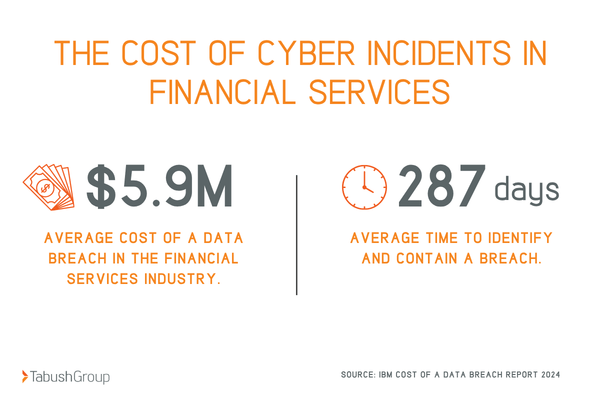
Financial firms handle sensitive data every day, including client records, trading information, and payment details. That makes your firm a target, and it's why regulators expect strong cybersecurity practices.
Compliance helps protect clients, maintain trust, and keep your business running smoothly. In a competitive industry, a strong security posture can also set your firm apart.
Which Cybersecurity Rules Apply To Your Financial Services Firm?
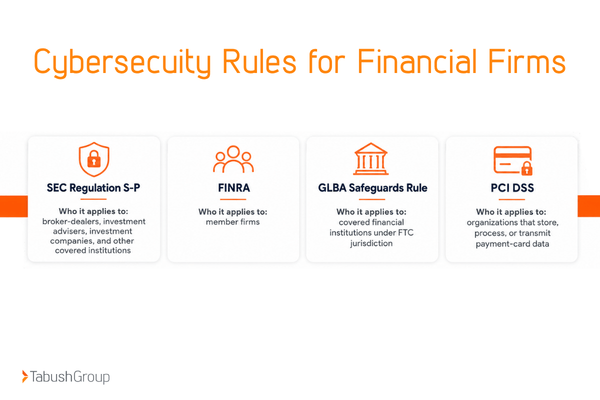
Start with scope. A strong compliance program begins by identifying the rules and standards that apply to your specific entity, regulator, services, and data environment.
Here’s the quick view.
|
Framework |
Who It May Apply To |
What to Know |
|
Broker-dealers, investment companies, SEC-registered investment advisers, funding portals, transfer agents, and other covered institutions |
Safeguarding customer information, written incident-response procedures, notification, and recordkeeping requirements. |
|
|
FINRA member firms |
Cybersecurity connects to supervision, business continuity, Regulation S-P, Regulation S-ID, and applicable books-and-records requirements. |
|
|
Financial institutions under FTC jurisdiction |
Requires a written information security program with administrative, technical, and physical safeguards. |
|
|
Organizations that store, process, transmit, or can affect payment-card data |
Industry security standard for cardholder-data environments; validation depends on role and payment relationships. |
Applicability varies by organization and regulator. Confirm your firm’s specific legal and regulatory obligations with legal or compliance counsel.
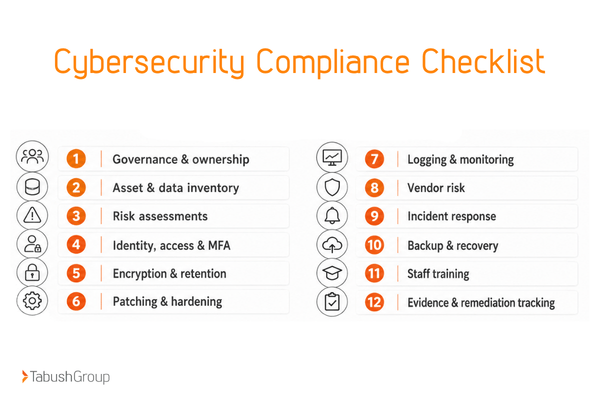
2026 Financial Services Cybersecurity Compliance Checklist
So, where do you start? Use these 12 control areas to organize the work and make ownership visible.
1. Assign governance and control ownership
Document executive accountability, security and compliance roles, escalation path, and review cadence. For firms covered by the FTC Safeguards Rule, this includes designating a Qualified Individual to oversee the information security program.
For FINRA, connect to supervisory systems/WSPs.
Evidence: role assignments, policies, meeting minutes, leadership reports.
2. Maintain an asset and sensitive-data inventory
Keep an inventory of hardware, software, SaaS, cloud systems, customer information, cardholder data, privileged accounts, and critical vendors. Assign an owner and data classification to critical systems.
Evidence: current inventory, data flow diagrams, system owners, classification.
3. Perform and document risk assessments
Identify foreseeable threats, evaluate impact/likelihood, map existing safeguards, and assign remediation owners. Update the assessment after material changes to the technology environment or business.
Evidence: dated risk assessment, remediation tracker, accepted exceptions.
4. Enforce identity, access, and MFA controls
Use least privilege, unique accounts, privileged-access review, timely deprovisioning, MFA, conditional access, and periodic access reviews. Microsoft 365 environments should also review administrative roles, MFA coverage, and device access policies.
Evidence: access-review records, MFA coverage report, termination checklist.
5. Protect sensitive data with encryption and retention controls
Address data at rest and in transit, secure transfer, retention, disposal, DLP, and key-management responsibilities. Avoid blanket claims or assuming every framework requires identical encryption settings.
Evidence: encryption configurations, retention policies, DLP reports, transfer procedures, and disposal records.
6. Patch, harden, scan, and test systems
Cover secure configurations, patch timelines, vulnerability scanning, penetration testing where applicable, endpoint protection, and remediation evidence. For PCI environments, keep scope and validation requirements clearly documented.
Evidence: patch reports, vulnerability scans, penetration-test results, endpoint reports, and remediation tickets.
7. Centralize logging and continuous monitoring
Define what systems log, who reviews alerts, escalation thresholds, retention, and after-hours coverage. If your internal team has limited after-hours coverage, document how responsibility is shared with an outside partner.
Evidence: logging configurations, monitoring reports, alert records, escalation procedures, and incident tickets.
8. Govern third-party and service-provider risk
Maintain vendor inventory, perform due diligence, define contract security expectations, monitor changes, and document incident notification paths. FINRA’s 2026 oversight materials continue to emphasize cybersecurity and third-party risk as important areas for member firms.
Evidence: vendor inventories, due diligence reviews, contracts, security questionnaires, and vendor-access records.
9. Maintain and test incident response procedures
Include detection, containment, investigation, communications, regulatory/customer decisioning, recovery, tabletop testing, and lessons learned.
Under amended Regulation S-P, covered institutions must provide affected-individual notice no later than 30 days after becoming aware of certain incidents. The FTC Safeguards Rule has a separate notification requirement requiring covered financial institutions to notify the FTC of certain events involving at least 500 consumers.
Evidence: incident-response plans, tabletop results, communication templates, incident logs, and lessons-learned reports.
10. Test backup, recovery, and business continuity
Verify backups are restorable, define recovery time objectives (RTO) and recovery point objectives (RPO), test recovery, and maintain alternate communications.FINRA Rule 4370 also requires member firms to maintain business continuity plans appropriate to their operations.
Evidence: backup reports, restore-test results, continuity plans, recovery exercises, and corrective-action records.
11. Train staff and document completion
Train your staff on phishing and social engineering, data handling, remote work, and incident reporting. Add role-based training for employees with elevated access or compliance responsibilities.
Evidence: completion reports, curriculum, attendance records, simulation results, and follow-up training.
12. Keep an evidence library and remediation tracker
For each control, retain the current artifact, owner, last review date, next review date, exception, and remediation status. A clean evidence library can make exams, audits, annual planning, and leadership reviews much easier to manage with less friction.
Evidence: the evidence library itself, remediation tracker, exception log, and recurring review calendar.
How The Controls Map Across SEC, FINRA, GLBA, and PCI DSS
Many controls can support several obligations at once. The exact legal or standards-based requirement still depends on the framework, so use nuanced mapping rather than a row of generic checkmarks.
|
Control area |
SEC Reg S-P |
FINRA |
FTC / GLBA |
PCI DSS |
|
Access / MFA |
Supports safeguarding requirements |
Supporting expectation / related obligations |
Direct safeguard area |
Direct requirement when in scope |
|
Vendor risk |
Direct service-provider requirements apply |
Major supervisory and risk area |
Service-provider oversight |
Applies to relevant third parties |
|
Incident response |
Direct requirement |
Related regulatory obligation |
Required security-program element |
Required response processes |
|
Logging/ monitoring |
Supports detection and response |
Expected risk-based control |
Supports safeguards |
Direct requirements when in scope |
|
Recovery |
Supports response and resilience |
Rule 4370 may apply |
Supports security program |
Relevant resilience controls |
|
Training |
Supports safeguards |
Risk-based expectation |
Required program component |
Required when in scope |
|
Evidence |
Recordkeeping requirements apply |
Supports supervision and exams |
Supports program documentation |
Required validation evidence |
Turn The Checklist Into A 90-Day Action Plan
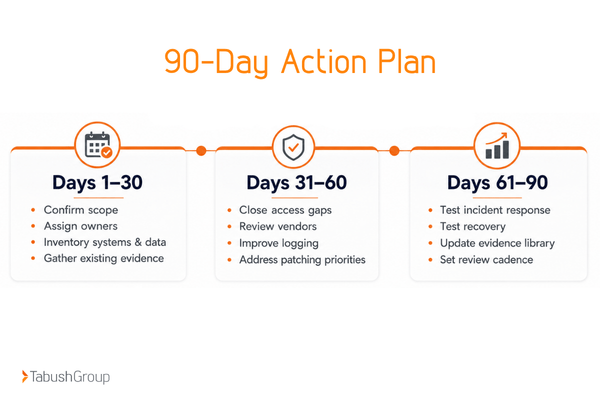
A giant checklist can get overwhelming fast. A 90-day sequence gives your team a clear starting line and keeps the highest-value work moving.
-
Days 1-30: confirm scope and which frameworks apply, assign owners, inventory systems and sensitive data, and gather current policies and evidence
-
Days 31-60: address identity, access, vendor, patching, and logging gaps, then clarify responsibilities between IT, compliance, leadership, and outside providers.
-
Days 61-90: test incident response and recovery, close priority remediation items, and then build review and evidence cadence.
Tabush Group can serve as an IT partner for financial services firms, helping operationalize the cybersecurity plan.
Turn Compliance Into a Competitive Advantage
Financial services firms often have strong internal IT and compliance teams that still need more capacity, specialized expertise, or consistent operational coverage. Tabush Group works with those teams to help put practical controls, support, and documentation into day-to-day use.
Explore Tabush Group’s IT solutions for financial services firms to find broader IT support aligned with the needs of regulated finance organizations. You can also review Tabush Group’s cybersecurity services, which are delivered as part of broader Tabush Group solutions.
If your team needs a point-in-time view of the current environment, the 360 IT Assessment provides an independent review of IT strengths and gaps. Its recommendations can be acted on with Tabush Group or another provider.
For more practical questions to use with your team, see Tabush Group’s Guide to Cybersecurity and cybersecurity questions to ask your IT team.
Frequently Asked Questions
What should a financial services cybersecurity compliance checklist include?
A financial services cybersecurity compliance checklist should cover risk assessments, data protection, access controls and MFA, encryption, vulnerability and patch management, security monitoring, incident response, employee training, vendor risk management, backups, business continuity, and ongoing compliance documentation.
Firms should also map these controls to the specific regulations and standards that apply to their business, such as GLBA, SEC Regulation S-P, FINRA requirements, and PCI DSS.
What cybersecurity regulations apply to financial services firms?
Cybersecurity requirements vary by the type of financial services firm. Common requirements include the Gramm-Leach-Bliley Act (GLBA) Safeguards Rule, SEC Regulation S-P, applicable FINRA rules and guidance, state privacy and breach-notification laws, and PCI DSS for organizations that handle payment card data.
Firms should identify which regulators have jurisdiction over their specific activities before building a compliance program.
Does FINRA have a cybersecurity rule?
FINRA does not have one standalone rule called the “cybersecurity rule.” Instead, cybersecurity obligations can arise under several requirements, including FINRA Rule 3110 on supervision, Rule 4370 on business continuity, SEC Regulation S-P, Regulation S-ID, and recordkeeping requirements.
FINRA also expects member firms to maintain cybersecurity programs and controls appropriate to their risk profile, business model, and size.
What does amended SEC Regulation S-P require for cybersecurity incident response?
Amended SEC Regulation S-P requires covered institutions to maintain written incident-response policies designed to detect, respond to, and recover from unauthorized access to or use of customer information.
With limited exceptions, affected individuals must be notified as soon as practicable and no later than 30 days after the firm becomes aware that unauthorized access or use occurred or is reasonably likely to have occurred.
Does PCI DSS apply to financial services firms?
Yes, PCI DSS can apply to financial services firms that store, process, or transmit payment-card data or can affect the security of the cardholder data environment. This can include banks, issuers, acquirers, processors, merchants, and service providers.
PCI DSS is an industry security standard rather than a federal regulation, and specific validation requirements are generally determined by payment brands or acquiring institutions.