Your firm already has internal IT. Maybe a controller or an office manager who took on the role, or a small IT team that handles the whole office.
While this may work for the day-to-day, the team is often stretched thin during busy season or when there are multiple competing priorities. This leaves their IT vulnerable to downtime and cyberthreats.
Co-managed IT services are the answer. Your internal team keeps ownership of your day-to-day technology while a third-party partner handles monitoring, cybersecurity, patch management, M365 Governance, and more, depending on your needs.
This post covers why accounting and finance firms feel this pressure, where the co-managed model fits, how it supports audit-ready controls, how it keeps your team from becoming overwhelmed, and what it looks like in one firm.
Key Takeaways:
-
Co-managed IT services let an accounting or finance firm keep its internal IT team and add depth and coverage from an outside partner.
-
It fits firms that already have some internal IT and get stretched at busy season, quarter-end, or audit peaks.
-
The firm owns day-to-day work and institutional knowledge, while the partner handles monitoring, security operations, backup continuity, reporting, after-hours coverage, and more based on your needs.
-
A co-managed partner supports SOX, SOC 2, and audit-readiness controls while the firm keeps ownership of its compliance obligations.
Why Accounting and Finance Firms Face Unique IT Pressure
IT is different for finance and accounting firms for a few reasons. The work runs on a predictable calendar, spikes hit at tax season and audit peaks, and the client data is highly regulated.
A system that runs smoothly during the summer will get pushed hard during tax season, at the end of a quarter, or during an audit.
Busy-Season Load
January to April, i.e., tax season, overlaps with the end of a quarter and audit peaks. During this time, concurrent users climb, temporary preparers come on board, and tolerance for downtime drops to near zero.
An outage that would be a minor annoyance in July can stall billable work during the busiest weeks of the year.
Client-Data Sensitivity and Regulation
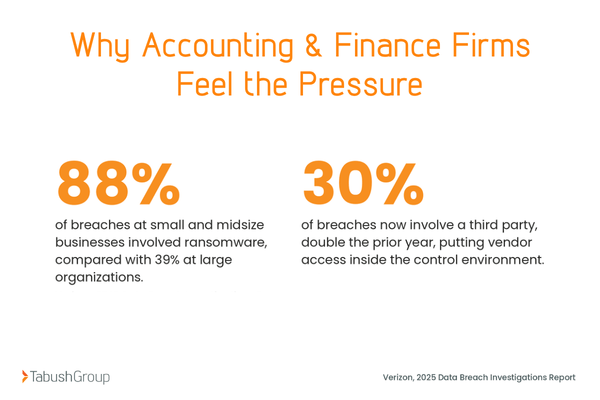
Ransomware appeared in 88% of breaches at small and midsize businesses, compared with 39% at large organizations, and most accounting firms sit squarely in that smaller band (Verizon, 2025 Data Breach Investigations Report).
Accounting and finance firms hold social security numbers (SSNs), tax returns, and financial records. This data is under GLBA, the FTC Safeguards Rule, and IRS WISP (Pub 5708).
Specialized Tax and Audit Software
Firms run on tools like CCH Axcess, UltraTax, Lacerte, Drake, ProSeries, QuickBooks, and CaseWare. Generic IT support learns these on your clock during the weeks you can’t afford to stall.
Additionally, peer reviews and client audits have extensive expectations for audit trail and documentation.
Where Co-Managed IT Fits
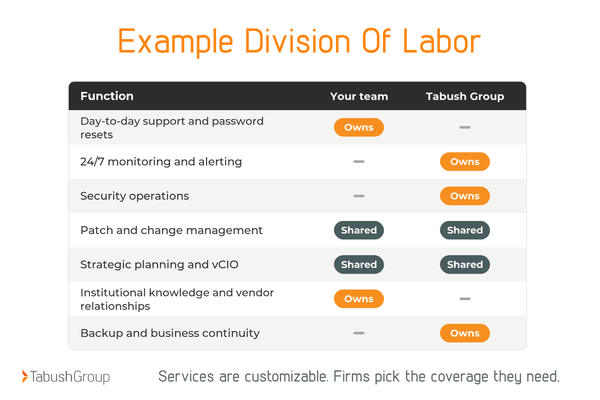
Co-managed IT is the best of both worlds. Your current internal team keeps ownership of the fundamental operations while your IT partner covers the rest. You keep the people who know your firm, and you add the coverage and specialization a small team cannot carry alone.
What Co-Managed IT Includes
Co-managed IT can include 24/7 monitoring and alerting, security operations, patch management, strategic guidance, and vCIO planning.
You can pick and choose. A firm might want only security operations, while another hands off monitoring and patching in full.
When Co-Managed Is The Right Fit
Co-managed is the right fit when a firm has some internal IT but needs more depth and coverage, without replacing its people. If your team is capable and simply stretched, or handles daily operations well and needs added security depth, the model closes the gap.
A firm with no internal IT at all is usually a better fit for fully managed services.
How Co-Managed IT Supports SOX and Audit-Readiness Controls
Audit reviews reward accounting and finance firms that can show their work. A co-managed partner helps you set up and document the access, change, and logging controls that SOX and audit-readiness reviews look for.
Plus, your firm keeps ownership of its compliance obligations throughout.
SOX, SOC 2, and WISP: What Applies To Whom
These frameworks can get blurred, so here is how to separate the frameworks cleanly.
-
SOX (Sarbanes-Oxley) applies to public companies and the firms that audit them
-
SOC 2 is an AICPA attestation about a service organization
-
GLBA, the FTC Safeguards Rule, and IRS WISP cover client-data safeguarding
IT General Controls A Co-Managed Partner Supports
IT general controls (ITGCs) are the baseline controls over access, change, and operations that keep financial systems reliable. They govern who can get in, how changes are approved, and how activity is recorded.
A co-managed partner supports the control environment with documented access controls, MFA, change management, audit logging, evidence retention, and an incident response plan.
Keeping Ownership With The Firm
Co-managed IT keeps the firm as the owner of its controls throughout, including compliance and policies. The partner helps document and operate these controls.
Your specific obligations depend on your clients and regulators, so treat this as a starting point for a conversation with your own advisors.
Staying Steady Through Busy Periods
Any firm knows that in order to survive the tax surge, you have to plan ahead. With the peak being predictable, you can arrange capacity well before the surge hits.
Planning Ahead For Busy Periods
Busy periods are predictable, so the work that protects them can happen in advance. Before peak weeks, your internal team and Tabush Group review the environment together: confirm systems are patched, check that monitoring is running, and test that backups restore cleanly.
Access is part of that plan. When a firm brings on extra people for a stretch, the team sets up their accounts correctly at the start, then removes that access cleanly when the work winds down.
The Co-Managed Split During Busy Season
During the surge, the co-managed split becomes necessary. Internal IT runs day-to-day while your partner absorbs monitoring and maintenance so you can keep up with demands.
A Real Co-Managed Scenario for A Finance Firm
Picture a finance firm with about 40 staff. They have one person, an office manager or a single internal IT, handling tech. This works great for most of the year, until spring hits.
They bring on temporary preparers and usage jumps, leaving this one-person IT team to keep things running. Now imagine a surprise audit or technical problem arises.
Luckily, under co-managed IT, your partner is already covering monitoring and maintenance, patch management, end-user assistance services, and IT enablement. This leaves your internal team members time to focus on the daily tickets and day-to-day tasks even during a surge.
This firm now gets through the busy season with steady coverage, tighter security posture, and audit-ready documentation.
This is what managed IT for accounting firms looks like when the internal team stays in place and gains support around it.
Work With A Co-Managed IT Provider Who Understands Your Firm
Co-managed IT gives accounting and finance firms a way to keep their current team while adding depth and capacity their industry demands.
When you choose a provider, look for someone who has experience with accounting and finance firms and their unique requirements.
Give your internal team the support they need before they burn out. Schedule a meeting today to learn what co-managed IT services could mean for your firm.
FAQs
What is co-managed IT for finance and accounting firms?
Co-managed IT for finance and accounting firms is a shared support model. The firm's internal IT staff keeps running day-to-day technology and institutional knowledge, and an outside partner adds monitoring, security operations, and project work. The internal team stays in control while gaining depth and coverage.
What does co-managed IT typically include?
Co-managed IT typically includes 24/7 monitoring and alerting, security operations, patch and change management, project delivery, advisory services, comprehensive reporting, flex professional services, M365 Governance, backup and business continuity, end-user assist services, and virtual CIO planning.
Firms can pick the services they need, so one might take only security, while another hands off monitoring and patching.
When should a finance or accounting firm choose co-managed IT?
A firm should choose co-managed IT when it already has some internal IT and needs more depth, wider coverage, or extra capacity so your team can stay focused during busy season, without replacing its people. Firms with no internal IT at all are usually a better fit for fully managed services.
How does co-managed IT support SOC 2 and SOX controls?
A co-managed partner supports the control environment behind SOC 2 and SOX with documented access management, MFA, change management, audit logging, evidence retention, and incident response.
The firm keeps ownership of its compliance obligations and attestations. SOX applies only to public companies and the firms that audit them.
How does co-managed IT handle busy periods?
Co-managed IT handles monitoring and maintenance, patch management, end-user assistance services, and IT empowerment. This leaves your internal team members time to focus on the daily tickets and day-to-day tasks even during a surge and doesn’t require your team to scramble to handle everything at once.